
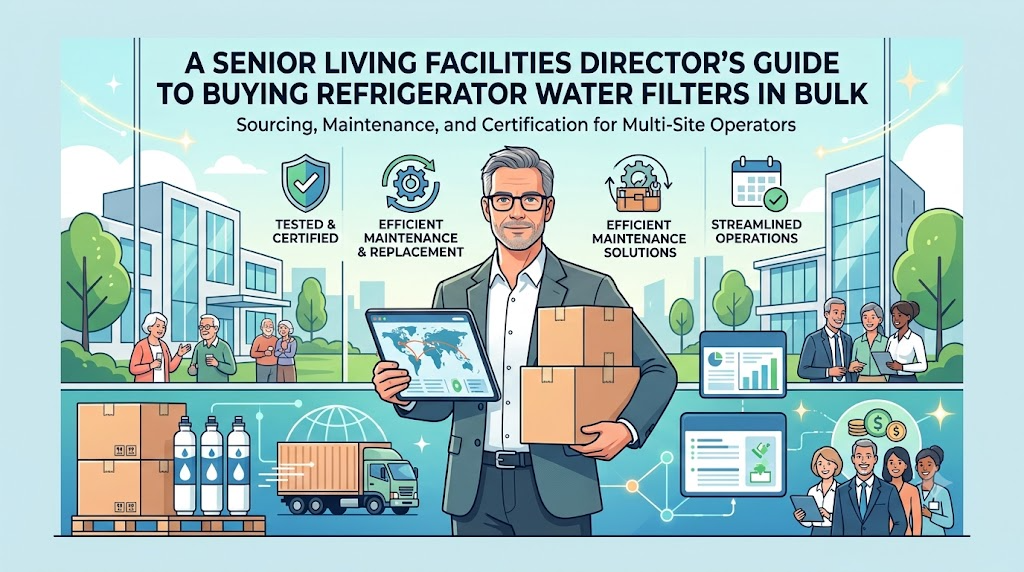
A resident's family touring an assisted living community isn't going to ask about NSF certification standards. But they might open the refrigerator in the model apartment, and if the water tastes like the tap, that registers — one more small signal about how carefully the place is run. Facilities and maintenance directors already know this instinct even if nobody's said it out loud: in senior living, small physical details get read as proxies for care quality, because a family choosing a community for a parent doesn't have much else to go on during a 45-minute tour.
That's the resident-experience side. The operational side is blunter: a senior living portfolio has the same mixed-fleet refrigerator problem as any multifamily property — different brands and models from different renovation waves, no single filter that fits everything — except the maintenance department responsible for keeping it stocked is turning over faster than almost any other role in the building.
The Same Mixed Appliance Fleet as Multifamily, With Fewer Full Kitchens
Independent living apartments generally come with full kitchens and standard-size refrigerators — the same Whirlpool, GE, Samsung, LG, Frigidaire, and Bosch units found in any market-rate apartment community, accumulated the same way: whatever the original developer specified, plus whatever a later renovation or emergency swap brought in. Assisted living units are smaller and usually built around a kitchenette instead of a full kitchen, but many still include a compact refrigerator with a water or ice dispenser, and where that dispenser exists, it runs through a filter just like its full-size counterpart. Memory care and skilled nursing communities are the exception — in-room kitchen appliances are less common there for resident safety reasons, and refrigerators tend to live in shared dining or common areas instead, which simplifies filter stocking rather than complicating it.
For an operator running some or all of those care levels under one roof — which describes most of the industry; one 2026 national workforce survey found 78.9% of responding organizations offered independent living, assisted living, memory care, and skilled nursing together — the result is a filter mix concentrated wherever full or compact kitchens exist. A community rarely stays standardized on one appliance brand past its first renovation cycle. In practice, the same six to eight filter families that cover most multifamily housing cover most senior living kitchens too: Whirlpool/Kenmore/Everdrop, the three non-interchangeable Frigidaire generations (FPPWFU01/PWF-1, ULTRAWF, and WF3CB), GE, LG, Samsung, and Bosch. True Marqet's wholesale program stocks all of them, plus a Sub-Zero-compatible cartridge for higher-end independent living buildings.
Maintenance Turnover Makes Tribal-Knowledge Sourcing Worse
A facilities director who has to explain "the ULTRAWF goes in the west wing, the WF3CB goes in anything renovated after 2019" to a new hire is relying on institutional memory that's leaving faster than it used to. Ziegler's July 2026 CFO Hotline survey of senior living and care operators found maintenance turnover jumped to 24.4% in 2026, up sharply from 16.7% the year before, even as total workforce turnover across all departments eased slightly to 35.4%. In the same survey, 21.5% of operators named housekeeping, environmental services, and maintenance roles collectively among their hardest positions to recruit and retain.
That's not a reason to panic — it's a reason to make filter sourcing resilient to staff turnover instead of dependent on one person's memory of which model goes where. A wholesale account with clearly labeled cases, ordered against an actual inventory of what's installed by building and unit type, survives a maintenance lead leaving in a way that "ask Dave, he's been here twelve years" doesn't.
What "NSF/ANSI 42 Certified" Actually Tells a Family
Somewhere between the tour and the lease signing, someone typically asks what's in the water — a resident's adult child, usually, doing the kind of due diligence people do when choosing a place for a parent. The honest answer is worth giving precisely, because vague reassurance is exactly what erodes trust with someone who's already anxious about the decision.
Most refrigerator water filters, True Marqet's included, are certified to NSF/ANSI 42. That standard covers aesthetic reduction — chlorine taste and odor — not NSF/ANSI 53, which covers contaminants with a recognized health effect, like certain heavy metals or parasites. The two certifications are independent of each other; a filter has to be tested and certified separately for each, and one doesn't imply the other. For a senior living community, "is the water safe" is a question your facility's actual water testing and municipal supply data answers — that's separate from what a refrigerator filter does. What the filter reliably does is take the chlorine taste and odor out of tap water. That's a small thing with a real effect: residents who find tap water unpleasant reach for bottled water, sugary alternatives, or nothing, and "nothing" is the worse outcome for everyone. Better taste, not better safety, is the accurate claim — and it's the more defensible one to give a family that will remember exactly what they were told.
Where Group Purchasing Doesn't Quite Reach
Many multi-site operators run some or all of their supply spend through a group purchasing organization. LCS Group Purchasing alone serves more than 2,100 senior living communities nationwide, and GPO contracts typically bundle food service, medical supplies, pharmacy, and general plant-operations categories under negotiated vendor terms.
But GPO coverage isn't universal, and it isn't always deep on narrow categories. In the same Ziegler survey, 58% of respondents identified as single-site organizations rather than part of a national multi-site group — no GPO leverage to speak of. And even a community that does belong to a GPO doesn't automatically get full coverage on something as specific as refrigerator filters split across six or seven incompatible model numbers; plant-ops contracts tend to optimize for the categories with the most total spend, not the smallest recurring line items. It's worth an afternoon to check: pull your actual appliance mix against what your GPO's plant-ops vendor stocks at negotiated pricing, and see whether there's a gap. If there is, a no-minimum wholesale account is a reasonable way to fill it without waiting for a contract renegotiation cycle.
Buying Wholesale vs. Piecing It Together
True Marqet's own single-unit price for a filter like the SK01 (Whirlpool/Kenmore/Everdrop-compatible EDR1RXD1/W10295370A) is $17.99 — reasonable for a one-off consumer order, not the number a facilities budget should be paying across dozens or hundreds of units a year. The wholesale program is built for that volume instead:
- No minimum order quantity — pricing improves with volume, but there's no case-count threshold to open an account
- Freight, customs, and duties built into the quote, not added as a surprise later
- Free shipping on orders of $500 or more
- Long shelf life, useful for building safety stock ahead of a renovation wave instead of ordering unit by unit
- Filters compatible with Whirlpool, Frigidaire, Pur, Samsung, LG, GE, Bosch, and more, from one supplier instead of several OEM parts channels
- PayPal, Payoneer, wire/ACH, and credit accepted, which covers most facilities and finance department AP setups without an exception process
If your portfolio spans several buildings or communities with different renovation histories, our guide to stocking refrigerator filters across a property portfolio walks through the inventory math in more depth — how many filter families to expect, how much buffer to hold, and how to avoid both stockouts and overbuying.
Frequently Asked Questions
Is there a minimum order quantity for senior living operators to get wholesale pricing?
No. True Marqet's wholesale program has no minimum order quantity. Pricing improves with volume, but a single-site community qualifies for a wholesale account on the same terms as a large multi-site operator.
Are True Marqet's refrigerator filters certified to remove health contaminants, or just for taste and odor?
Most are certified to NSF/ANSI 42, which covers aesthetic reduction — chlorine taste and odor. That's a separate, independent certification from NSF/ANSI 53, which covers contaminants with a recognized health effect. Check the individual product listing before telling a resident or family member a filter does more than improve taste.
How many different filter models does a typical senior living portfolio need to stock?
Most conventional independent living and assisted living kitchens are covered by six to eight filter families: Whirlpool/Kenmore/Everdrop, three separate Frigidaire generations, GE, LG, Samsung, and Bosch. Higher-end independent living buildings with built-in units may also need a Sub-Zero-compatible filter.
Does a wholesale account replace our group purchasing organization contract?
Not necessarily — it can complement it. GPO contracts are usually strongest on high-spend categories like food and medical supplies, and don't always deeply negotiate narrow categories like refrigerator filters across multiple incompatible models. Since there's no minimum order quantity, opening a direct wholesale account costs nothing to try alongside existing GPO relationships.
What payment methods does True Marqet's wholesale program accept?
PayPal, Payoneer, wire/ACH transfer, and credit card.
Can a single nonprofit community — not a multi-site operator — open a wholesale account?
Yes. There's no minimum order quantity and no requirement to operate multiple communities. Pricing scales with order size, not organization size.
Ready to Set Up a Wholesale Account?
If your maintenance team is sourcing refrigerator filters one at a time between other work orders, a wholesale account is a low-effort way to standardize that, cut the per-unit cost, and stop depending on any one person remembering which filter goes where. Visit True Marqet's wholesale program to see current terms, or email wholesale@truemarqet.com directly with your community's or portfolio's appliance mix and unit count — the team typically responds within one business day.