
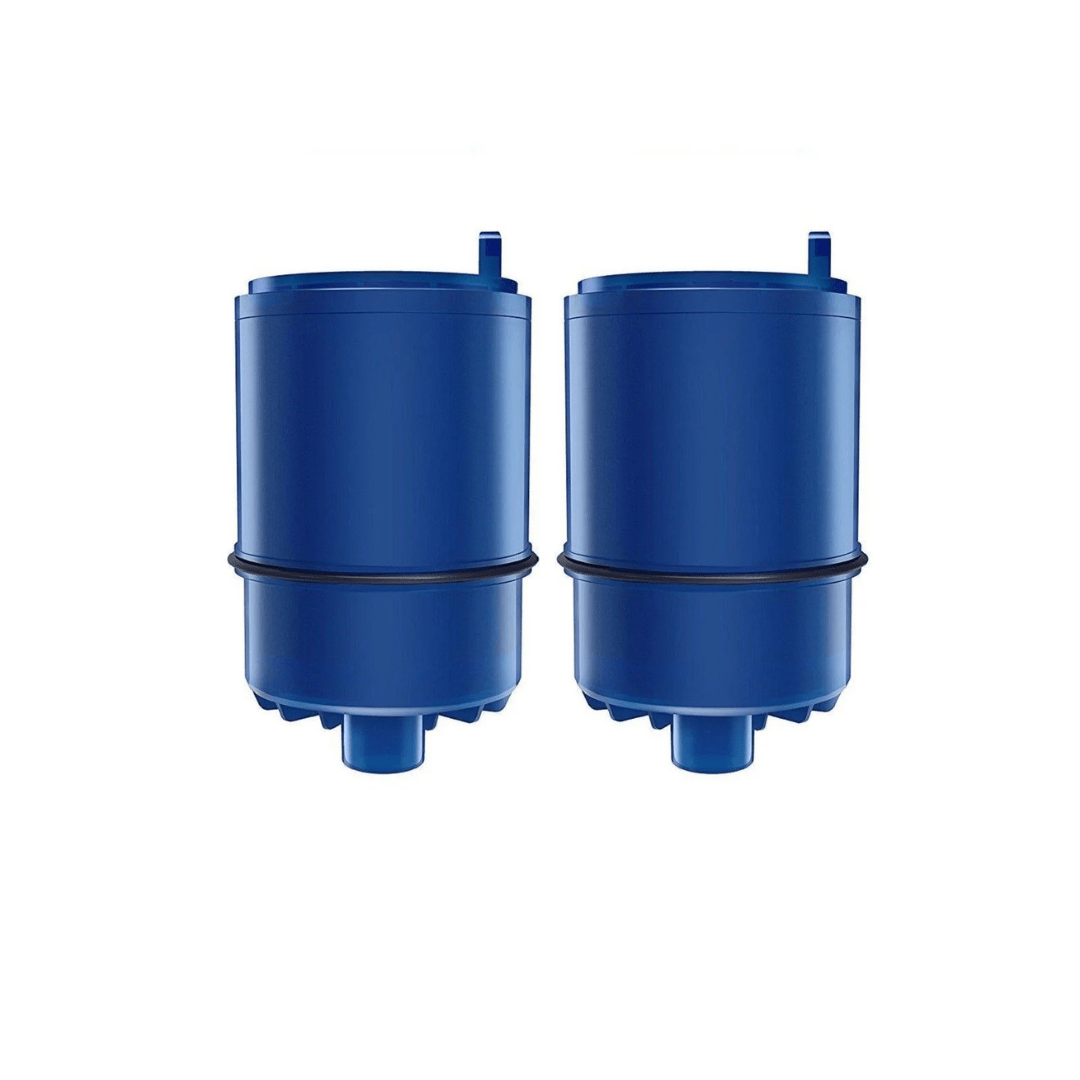
If you have ever flipped a PUR faucet filter to "filtered" and then turned the handle toward hot to fill a pot, you are in good company. It is also exactly what PUR tells you not to do. PUR's documents are blunt on this point: cold water only. What they disagree on, slightly, is how cold.
What PUR says about water temperature
PUR's faucet-mount manual says: "Never run hot water through the filter." It gives a usable range of 34°F to 100°F (1°C to 38°C) and warns that water above 100°F may damage the filter.
A newer PUR performance data sheet for the RF9999 cartridge is stricter. It lists a maximum usable temperature of 82°F (28°C) and the same 34°F minimum.
Two documents, two ceilings. The safe reading is the lower one. Hot tap water from a water heater is typically far above either number, so the practical rule is simple: set the handle to full cold before you switch the diverter to "filtered," and switch back to unfiltered for anything warm.
Why the filter slows down (and why that is normal)
Faucet-mount cartridges hold carbon block that traps particles as water passes through it. As that block loads up, flow in the filtered position drops. PUR's manual states it directly: when the filter is near end of life, water runs slower in the filtered position, and the fix is to replace the cartridge.
So slow flow is usually a replacement signal, not a plumbing fault. Before you assume that, rule out one thing: a new cartridge that was not flushed. PUR says to run cold water through a new cartridge for 5 minutes, and cloudy water during that flush is normal.
Your home's water pressure matters a little too. PUR lists a minimum working pressure of 20 psig for these units, which almost every household exceeds, but a faucet with a clogged aerator can make a healthy filter feel slow. Unscrew the aerator and rinse it before blaming the cartridge.
How often to replace an RF-9999
PUR rates faucet-mount cartridges for 100 gallons. The manual adds a time limit: 3 months, whichever comes first. The data sheet only gives the 100-gallon figure.
For a household that runs the filtered side for drinking and cooking, that works out to roughly a gallon a day, which is why three months is the common rule of thumb. Fill a few large water bottles every day, or cook with a lot of filtered water, and you will hit 100 gallons sooner.
Reading the indicator light
The unit has a battery-powered light that changes with use. The manual labels the stages "Filter is working," "Change filter soon," and "End of filter life," and says the light flashes green six times when you start a new filter. Installing a new cartridge resets it.
The light's battery is not replaceable. PUR notes that when it dies the filter still works, so a dark light is not a reason to throw out a good cartridge. Just go back to counting months.
RF-9999 vs. RF-3375: match the cartridge to the box
PUR sells two faucet-mount cartridges, RF-3375 (its standard "PUR Filter") and RF-9999 (the "PUR PLUS Filter"), and its data sheets list them in separate performance columns. The sheets list both against the whole faucet-unit family, but older manuals pair specific units with a specific cartridge. Check the number printed on your current cartridge or in your unit's manual and buy that one.
About replacement cartridges and certifications
PUR's NSF/ANSI 42, 53 and 401 certifications apply to PUR's own systems as tested. A third-party replacement is a different product. The True Marqet replacement for the PUR PLUS RF-9999 is sold as a compatible cartridge that reduces chlorine, taste and odor, and its listing does not claim NSF certification, so don't read PUR's lead or contaminant results as applying to it. If lead or other health-related contaminants are your reason for filtering, check your local water report and use a cartridge whose certification you can verify.
Frequently Asked Questions
Can I run hot water through a PUR faucet filter?
No. PUR's manual says never to run hot water through it and gives 100°F as the damage threshold. PUR's newer data sheet lists 82°F as the maximum usable temperature, so treat anything warmer than cool tap water as off limits.
Why is my PUR faucet filter so slow?
Most often the cartridge is nearing the end of its life; PUR says flow in the filtered position slows as it does. If the cartridge is new, make sure it was flushed with cold water for 5 minutes, and rinse a clogged faucet aerator.
How often should I change a PUR faucet filter?
PUR rates the cartridge for 100 gallons, and its manual says to change it every three months, whichever comes first.
Does the indicator light have to work for the filter to work?
No. PUR says the light's battery can't be replaced and that the filter is still functional when the battery stops working. Track the date you installed the cartridge instead.
Why is the water cloudy after I install a new filter?
PUR says cloudiness during the 5-minute cold flush of a new cartridge is normal. Keep flushing for the full five minutes before drinking.
Is RF-9999 the same as RF-3375?
No. PUR lists them as separate cartridges ("PUR PLUS" and "PUR") with their own performance data. Buy the model number your unit's manual or current cartridge specifies.
Sources: PUR faucet-mount owner's manual; PUR RF9999 and RF3375 performance data sheets (pur.com).