
Search "hydrogen water skin benefits" and you'll get a wall of before/after photos and phrases like "glowing" and "youthful" with nothing behind them. That's the problem for anyone actually trying to evaluate whether it's worth adding to a routine: skin change is slow, lighting in selfies isn't consistent, and placebo effect is real when you want something to be working.
This isn't a guide to whether hydrogen water is good for your skin in the abstract — plenty of general content already covers that. It's a guide to how you'd actually know, personally, four to eight weeks in, whether anything measurable changed.
Why "I Think My Skin Looks Better" Isn't Data
Three things make skin self-assessment unreliable:
- Lighting and angle drift. A phone selfie taken in different light, at a different time of day, isn't a controlled comparison — small variations swamp small real changes.
- Slow timelines. Skin hydration and elasticity shift gradually. Without a baseline number, it's easy to miss real change or imagine change that isn't there.
- Expectation bias. If you bought a product hoping it would help, you're primed to see improvement whether or not it occurred. This isn't unique to hydrogen water — it's true of every skincare and wellness product.
The fix isn't to distrust your skin routine. It's to add a number to it.
What's Actually Behind the Skin Angle
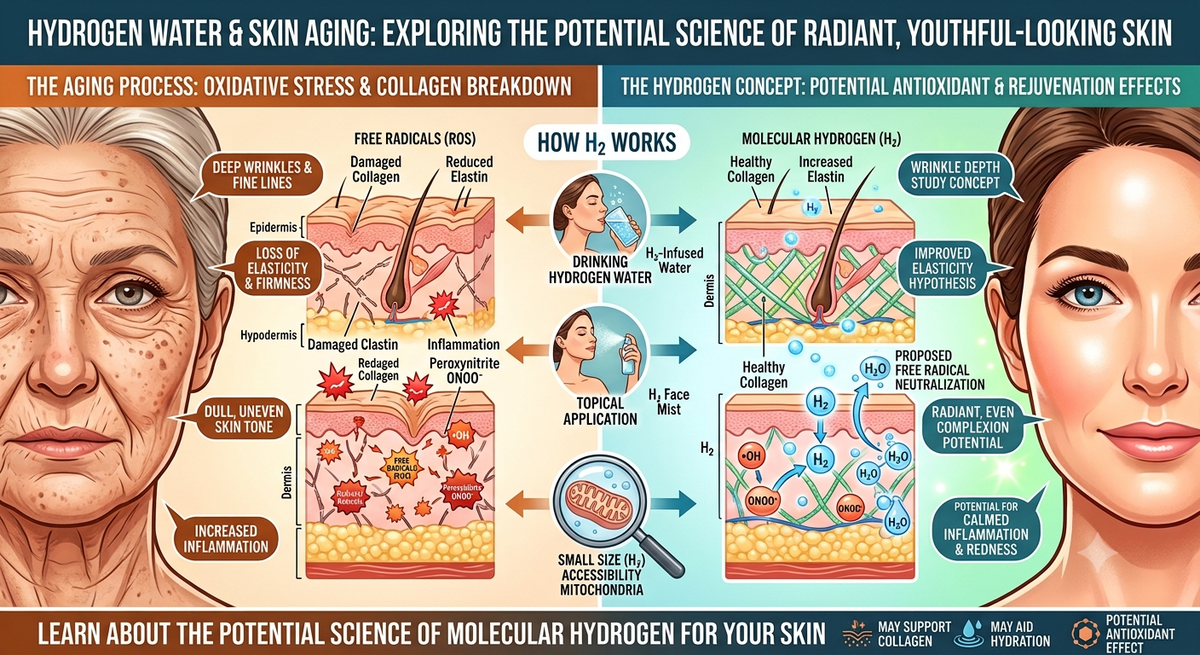
Molecular hydrogen (H2) is studied as a selective antioxidant: research suggests it targets some of the more reactive, damaging free radicals (like the hydroxyl radical) while leaving the reactive oxygen species your cells use for normal signaling alone. It's also studied as a trigger for the body's own antioxidant enzyme systems (SOD, catalase) and as having a role in lowering markers of oxidative stress and inflammation.
Oxidative stress and chronic low-grade inflammation are both frequently discussed in skin-aging research as contributors to the visible signs of aging — loss of elasticity, uneven tone, fine lines. That's the mechanism-level connection between H2 and skin. It is not the same as a guarantee of visible anti-aging results, and no reputable source should promise you one. Treat it as "a plausible pathway worth testing on yourself," not a proven outcome.
Four Ways to Actually Measure It (Ranked by Accessibility)
- A controlled phone-photo baseline. The free option. Same spot, same lighting (ideally daylight near a window, same time of day), same distance, no filter, once a week. Not lab-grade, but far better than memory or random selfies — and free.
- A home skin-hydration meter. Handheld corneometer-style devices exist at consumer price points and give you a repeatable hydration number for the same patch of skin, tested the same way each time. This is the most accessible quantitative option for tracking hydration specifically.
- An esthetician or dermatologist skin analysis. Many skin clinics and med-spas offer imaging analysis (wrinkle depth, pore size, pigmentation, sometimes elasticity) as a standalone service, not just a sales pitch for their own products. Booking one before you start and one 6-8 weeks later gives you a professional-grade before/after that isn't just a photo.
- A cutometer reading, if you can access one. Less commonly available outside dermatology or research settings, but it's the gold-standard way to quantify skin elasticity specifically. Worth asking a local dermatologist's office if they offer it as a standalone measurement.
The point isn't to do all four. It's to pick at least one number — hydration reading, elasticity reading, or a professional imaging report — and check it again after a defined period, instead of relying on impression alone.
A Simple Tracking Protocol
- Baseline first. Take your measurement (photo, hydration reading, or professional scan) before changing anything else in your routine.
- Change one variable. If you're testing hydrogen water specifically, don't simultaneously overhaul your skincare products — you won't know which change did what.
- Re-measure on a schedule, not a whim. Every 2 weeks is reasonable; skin research generally looks at 4-8 week windows before drawing conclusions, so don't expect (or claim) results at day 3.
- Log hydration too, not just skin. If you're drinking more water generally (hydrogen-infused or not), track ounces per day alongside your skin metric — plain hydration is itself a variable you need to separate out.
Where Water Quality Fits In
If part of the appeal is drinking more water in general — hydrogen-infused or otherwise — it's worth knowing that not all hydrogen generators produce clean output. Devices without a proper proton-exchange membrane (PEM) can generate trace byproducts like chlorine or ozone alongside the hydrogen gas. That's a separate issue from whether hydrogen itself "does anything," but if you're specifically optimizing a routine for skin, drinking water free of those byproducts is a reasonable baseline requirement, not an incidental detail. Look for generators that specify SPE/PEM membrane construction with titanium or platinum electrodes, and a stated, tested PPB output — that's the difference between hydrogen-rich water and water that just looks like it via a light-up display.
FAQ
Does hydrogen water actually help with skin aging?
There's mechanism-level research suggesting molecular hydrogen supports the body's antioxidant systems and may help reduce markers of oxidative stress and inflammation, both of which are discussed in skin-aging research generally. That's a plausible pathway, not a proven cosmetic outcome — the honest answer is "it's worth testing on yourself with real measurements," not "yes, guaranteed."
How long before I'd see a measurable difference in my skin?
Skin-related research generally looks at 4-8 week windows rather than days, and broader hydrogen-water wellbeing studies commonly report noticeable effects around 4-6 weeks. Give any routine change at least a month before drawing conclusions, and measure at the start and end of that window rather than relying on memory.
What's the easiest way to track this without buying equipment?
A controlled phone-photo baseline — same location, same lighting, same time of day, weekly — is free and better than nothing. It won't give you a hydration or elasticity number, but it removes a lot of the lighting and memory bias that makes casual before/afters unreliable.
Is a home hydration meter accurate enough to bother with?
Consumer corneometer-style devices won't match clinical equipment, but they're consistent enough to track change over time on your own skin if you measure the same spot the same way each time. For personal tracking rather than clinical diagnosis, that consistency is what actually matters.
Should I change my whole skincare routine at the same time I start hydrogen water?
No — if the goal is to know whether hydrogen water specifically is doing anything, change one variable at a time. Overhauling your serums, water, and diet simultaneously means you won't be able to attribute any change you do measure.
Does the quality of the hydrogen generator matter if I'm focused on skin, not just hydration?
Yes. Devices without a proper SPE/PEM membrane can produce unwanted byproducts like trace chlorine or ozone instead of clean hydrogen gas — not something you want in water you're drinking as part of a skin-focused routine. Look for a stated PPB output and titanium/platinum electrode construction rather than a device that just claims "hydrogen" on the box.
True Marqet builds hydrogen water bottles and pitchers with SPE/PEM membranes and titanium/platinum electrodes, so the water you're testing your own routine with is clean, hydrogen-rich, and verifiable — not just labeled that way. If you're going to spend eight weeks tracking your skin, the water itself shouldn't be the variable you're unsure about.