
Search "does hydrogen water improve athletic performance" and you'll get two kinds of answers: brand copy that says yes without qualification, and skeptics who say the whole category is placebo. Neither one is reading the actual research carefully. The most specific study on this — a 7-day cycling trial — found something more interesting than either camp is saying: hydrogen water worked, but only for the athletes who were already fit.
The Study: 7 Days, Two Groups, One Surprising Split
In 2021, a team led by Rafael Timón published a double-blind, placebo-controlled crossover study in Biology of Sport testing hydrogen-rich water (HRW) on 37 volunteers split into two groups: 12 trained amateur cyclists and 15 untrained subjects. Every participant drank both a placebo and nano-bubble hydrogen-rich water (1.9 ppm H2, -600 mV oxidation-reduction potential) for seven days each, in randomized order, with performance tested via an incremental VO2max test and a maximum anaerobic power test at the end of each phase.
Neither group improved on the VO2max (aerobic) test — hydrogen water didn't change endurance capacity for anyone. The anaerobic test is where the groups diverged. Trained cyclists, after 7 days of HRW, posted:
- Peak power: 766.2 → 826.5 watts (a ~60W jump)
- Mean power: 350.0 → 380.2 watts
- Fatigue index: 77.6% → 75.1% (lower is better)
Untrained subjects showed no significant change on any of those measures, on either the placebo or the hydrogen water. Same protocol, same water, same seven days — different bodies, different result.
Why Training Status Might Be the Variable That Matters
The study's authors frame this as the ergogenic effect being "mediated by training status," and the mechanism they point to lines up with how hydrogen is thought to work at the cellular level: H2 acts as a selective antioxidant, neutralizing the most damaging free radicals (hydroxyl radicals, peroxynitrite) generated during intense effort, without wiping out the reactive oxygen species your body actually needs for muscle adaptation and signaling.
Trained athletes generate a different oxidative stress profile under load than untrained people do — years of training changes how much oxidative byproduct a hard anaerobic effort produces and how the body buffers it. One plausible read: untrained subjects in the study simply weren't pushing hard enough, consistently enough, to generate the kind of oxidative load where a selective antioxidant has much to clean up. A 2024 review in Metabolites (Zhou et al.) surveying the broader hydrogen-and-exercise literature reached a similar overall conclusion — most studies point toward a real performance effect, a minority find nothing, and the variation across studies (protocol, dose, training status, sport) is exactly why results look inconsistent from the outside.
What This Means If You're Not a Competitive Athlete
If you're newer to structured training, this study is a reason to keep your expectations calibrated rather than a reason to skip hydrogen water altogether. It measured one outcome — anaerobic cycling power over 7 days — in one population. It didn't test recovery markers, resistance training, longer intake windows, or endurance athletes specifically, all of which show different (and sometimes more positive) results in other trials. But if peak power output is the specific benefit you're chasing and you're several months into consistent training rather than years into it, this is the honest baseline: the clearest data we have says the effect shows up once your training age catches up to it, not necessarily on day one.
The Legal Angle: Why This Matters for Competitive Athletes Specifically
One detail that gets lost in most hydrogen water content: the World Anti-Doping Agency doesn't restrict molecular hydrogen. For athletes competing under WADA or similar bodies, that makes HRW one of a short list of legal ergogenic aids with actual peer-reviewed backing, rather than a gray-market supplement. That's a meaningfully different category than most "performance" products on the shelf next to it.
Measure It Instead of Guessing
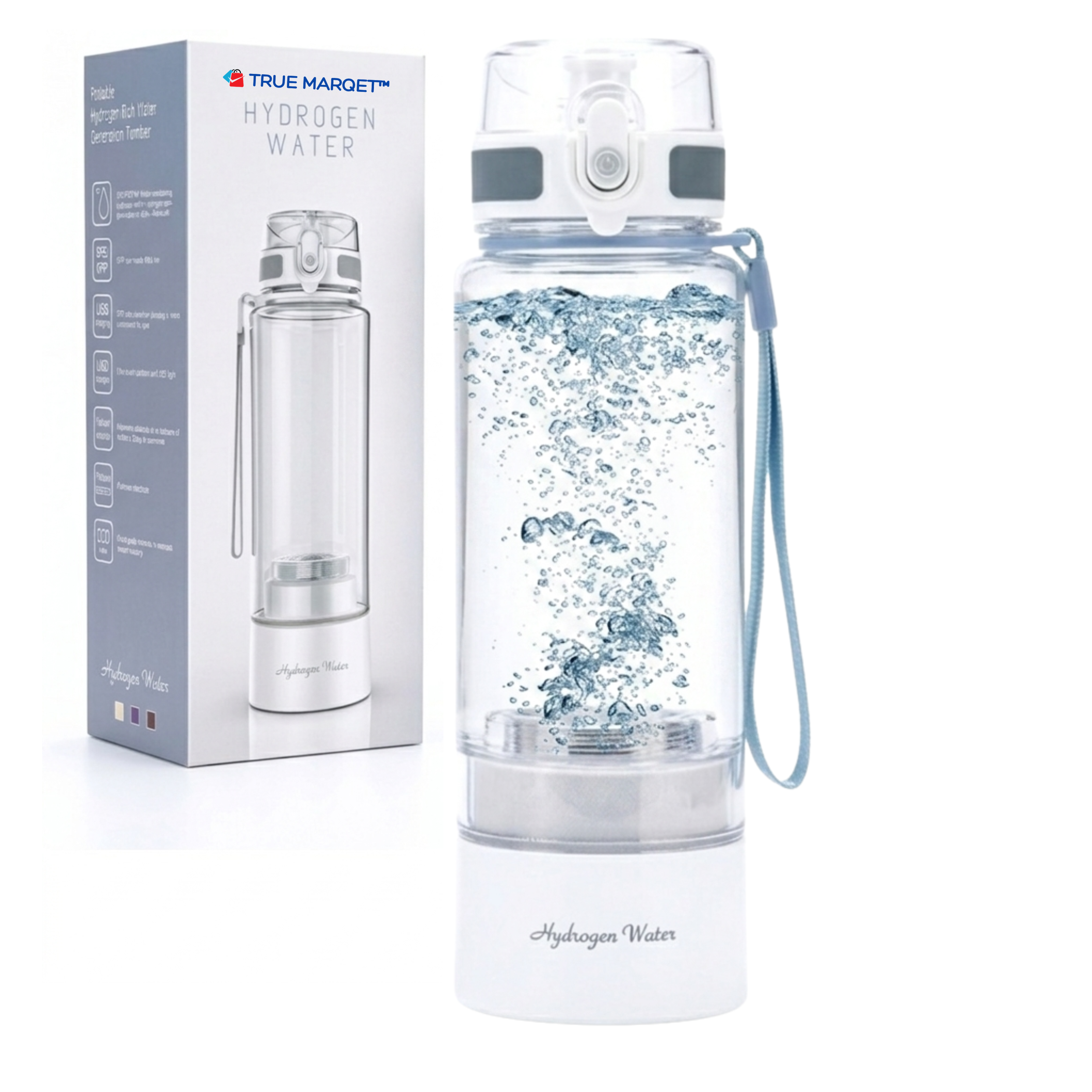
The honest takeaway from a study like this is that individual response varies — which is exactly why we built True Marqet around giving people a way to check their own results instead of taking a bottle's word for it. If peak power is what you're tracking, a basic power meter or even a Wingate-style test at your gym will tell you in a week whether hydrogen water is doing anything for your numbers specifically. Our H2GO bottle (titanium and platinum electrodes, SPE/PEM electrolysis, tested output up to 3,003 PPB) is built for the kind of consistent daily use a 7-day protocol like this one requires — but the number that matters is the one you measure on yourself, not the one on our packaging.
FAQ
Does hydrogen water help you run faster or improve endurance?
Not according to this study — neither trained nor untrained participants improved on the VO2max (aerobic/endurance) test after 7 days of hydrogen water. The performance effect that showed up was specific to anaerobic power output in trained cyclists, not aerobic endurance.
How long do you have to drink hydrogen water before you'd notice a performance difference?
The cycling study used a 7-day intake protocol before testing, which is the shortest window with documented anaerobic benefits. Other research on inflammation and metabolic markers suggests noticeable effects commonly build over 4–6 weeks, so 7 days may be closer to a floor than a typical timeline.
Is hydrogen water banned for competitive athletes?
No. Molecular hydrogen is not on the World Anti-Doping Agency's prohibited list, which is part of why it's drawn interest from athletes in tested sports looking for a legal option with research behind it.
I'm not an athlete — is hydrogen water still worth trying?
The cycling study only measured anaerobic power, which is one narrow outcome. Separate research has looked at inflammation, blood lactate, and recovery markers in broader populations with more encouraging results — this particular study just doesn't tell you much either way if performance power output isn't your goal.
Why did untrained subjects see no benefit at all?
The study's authors can't fully explain it, but the leading theory ties back to how hydrogen works — it selectively neutralizes the free radicals produced during high oxidative stress. Untrained subjects likely weren't generating the same intensity of oxidative load during the anaerobic test, leaving less for a selective antioxidant to act on.
What dose or concentration was used in the study?
Participants drank nano-bubble hydrogen-rich water at 1.9 ppm (parts per million) hydrogen concentration, with an oxidation-reduction potential of -600 mV, for 7 consecutive days before each test phase.
Clean water first. Enhanced water next. If you're already training hard and want to see whether hydrogen water moves your own numbers, the only way to know is to test it on yourself — that's the whole idea behind how we build.
Sources cited:
Timón, R., Olcina, G., González-Custodio, A., Camacho-Cardenosa, M., Camacho-Cardenosa, A., & Martínez Guardado, I. (2021). Effects of 7-day intake of hydrogen-rich water on physical performance of trained and untrained subjects. Biology of Sport, 38(2), 269–275.
Zhou, Q., Li, H., Zhang, Y., Zhao, Y., Wang, C., & Liu, C. (2024). Hydrogen-Rich Water to Enhance Exercise Performance: A Review of Effects and Mechanisms. Metabolites, 14(10), 537.