If you've priced out wholesale refrigerator water filters before, you already know the first wall you hit usually isn't the per-unit cost. It's the minimum order. A lot of suppliers won't even quote a price until you commit to 5,000, 10,000, sometimes 50,000+ units — a real problem if you're testing a new SKU on Amazon, filling out a Walmart WFS catalog, or just don't want six figures of inventory sitting in a storage unit before you know if it sells.
The Real Bottleneck Isn't Price — It's Minimum Order Quantity
Most manufacturers set MOQs based on their own production runs, not around what makes sense for a reseller testing demand. That's fine if you're an established distributor moving pallets. It's a dead end if you're a smaller Amazon or Walmart seller who wants to add a filter SKU without betting the business on it.
True Marqet's wholesale program runs the other direction: no minimum order quantity. Pricing scales down per unit as your order size goes up, so you can start small, see how a listing performs, and reorder heavier once you have real sales data — instead of guessing upfront and hoping the guess was right.
What NSF/ANSI 42 Certification Actually Covers (and Why the Distinction Matters)
Anyone reselling water filters should know the difference between NSF/ANSI 42 and NSF/ANSI 53, because customers increasingly ask, and getting it wrong is the fastest way to lose credibility on a product listing.
Per NSF International's own standards page, NSF/ANSI 42 certifies a filter to reduce aesthetic impurities — chlorine taste and odor — while NSF/ANSI 53 certifies reduction of a contaminant with an established health effect as regulated by the EPA or Health Canada. They're not interchangeable, and a filter certified under one isn't automatically certified under the other. NSF is also explicit that certification under either standard doesn't mean a filter reduces every possible contaminant — only the specific ones it was tested against.
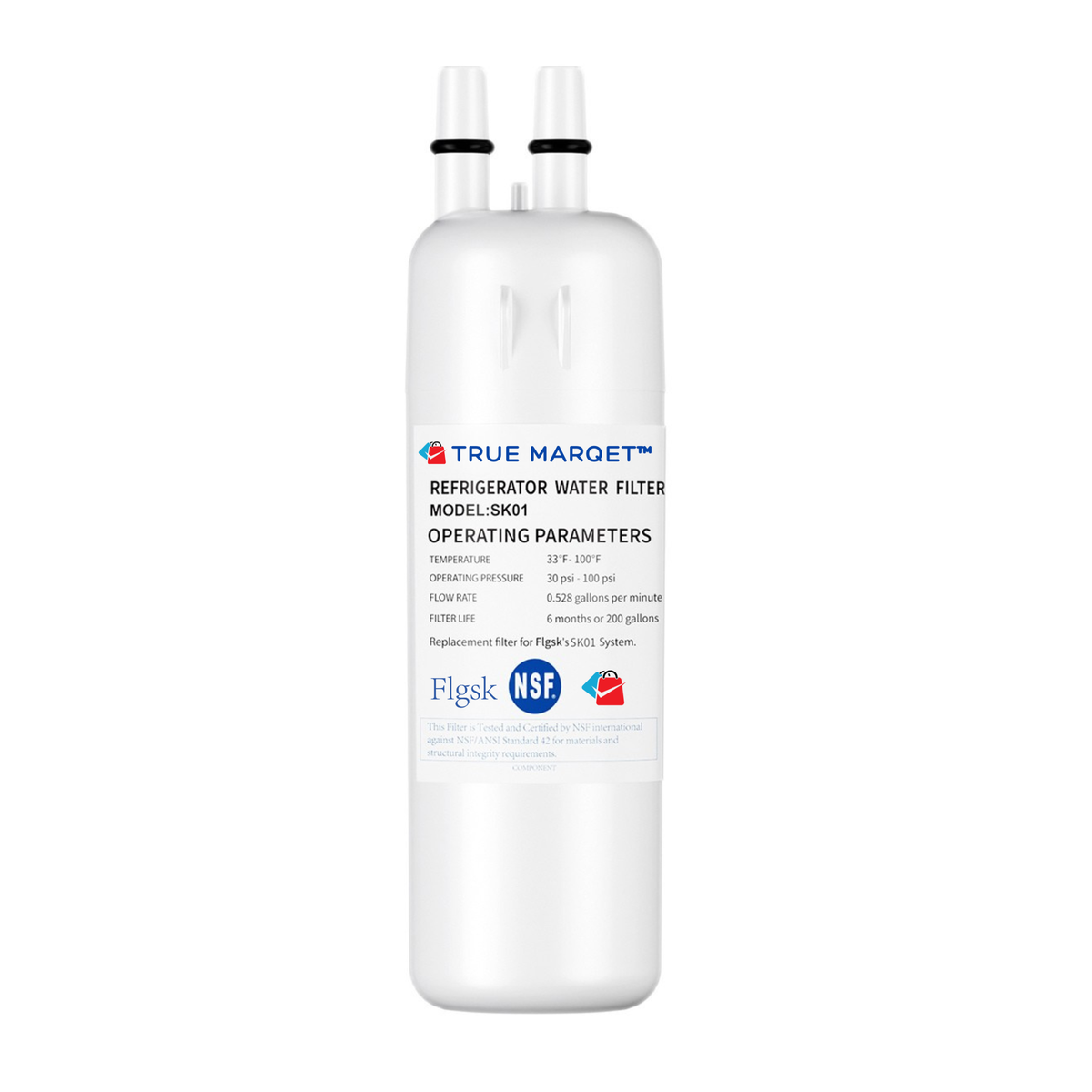
The majority of True Marqet's filter lineup is NSF/ANSI 42 certified. That's a real, verifiable claim about taste and odor reduction — it's not the same thing as a health-contaminant claim, and any listing copy should keep that distinction intact rather than blurring the two standards together.
Cross-Reference Compatibility: The Model Number Is the Whole Game
Refrigerator filter buyers don't search by brand name — they search by the number stamped on their old cartridge, or the fridge model number, because that's the only way to know a replacement will actually fit. A reseller's product page lives or dies on getting those cross-references right: DA29-00020B and HAF-CIN for Samsung, EDR1RXD1 and W10295370A for Whirlpool/Everydrop, LT1000P and ADQ747935 for LG, XWF and MWF for GE, Ultra Clarity Pro for Bosch, and dozens of others across Frigidaire, Sub-Zero, and Pur.
This is also where a wholesale supplier is worth vetting directly instead of assuming: ask what percentage of common models they cross-reference, and what happens when a customer needs one that isn't in the current catalog. A supplier that can quickly confirm compatibility on a model you don't already carry saves you from either turning away a sale or guessing wrong on a listing.
What Amazon FBA and Walmart WFS Sellers Specifically Need From a Supplier
Beyond the filter itself, the operational stuff is what actually determines whether a wholesale relationship is worth the hassle: Does the supplier handle freight, customs, and duties inside the quote, or do those show up as surprises later? Do they provide barcodes, or do you have to generate and apply your own before anything can go into FBA or WFS? Can they prep and label inbound shipments to spec, or does that fall entirely on you?
True Marqet's wholesale program includes free barcode generation and FBA/WFS inbound prep as part of the standard offer, with freight, customs, and taxes built into the quote rather than added afterward — the kind of detail that matters far more once you're actually moving cases than it does while you're still comparing price sheets.
White Label and Custom Packaging: When It's Worth Asking For
Custom-branded packaging or blank-box options are available on qualifying wholesale orders. It's not something every reseller needs on day one — if you're testing a new SKU, generic packaging under the manufacturer's branding is the faster, lower-risk way to start. White label becomes worth the extra lead time once a listing has proven itself and you're ready to build it as your own brand rather than a resold one.
A Short Checklist Before You Commit to Any Wholesale Filter Supplier
Before signing on with any supplier — True Marqet included — it's worth getting straight answers to a handful of questions: What's the actual MOQ, and does pricing improve at higher volumes? Which specific standard (42, 53, both) is the filter certified under, and does that match what you plan to claim on your listing? Which cross-reference models are confirmed in stock right now versus available on request? Who handles freight and customs, and is that reflected in the quoted price or added later? And what payment terms are available — PayPal, wire/ACH, and credit all work differently depending on your cash flow.
FAQ
Do refrigerator filter wholesalers require a minimum order?
Most do — frequently in the thousands of units before they'll even provide pricing. True Marqet's wholesale program has no minimum order quantity; per-unit pricing simply improves as order size increases.
What's the difference between NSF/ANSI 42 and NSF/ANSI 53 for resale filters?
NSF/ANSI 42 certifies reduction of aesthetic issues like chlorine taste and odor. NSF/ANSI 53 certifies reduction of a specific contaminant with a recognized health effect, as regulated by the EPA or Health Canada. A filter can be certified under one, both, or neither — check which applies before making a claim on a listing.
Can I sell refrigerator filters on Amazon or Walmart without holding my own barcode inventory?
True Marqet's wholesale program includes free barcode generation as part of the standard offer, along with FBA/WFS inbound prep, so resellers don't need to set up that infrastructure separately before their first order.
Do I need my own branding to resell wholesale filters?
No — custom packaging and white-label options are available on qualifying orders, but they're optional. Many resellers start with standard packaging while testing a listing, then move to private label once the SKU is proven.
How do I know if a specific fridge filter model is available in bulk?
Cross-reference the model number stamped on the old filter or the refrigerator's model number against the supplier's catalog. True Marqet stocks common cross-references for Samsung, Whirlpool, LG, GE, Bosch, Frigidaire, Sub-Zero, and Pur models, and can typically confirm additional ones on request.
What payment methods are typical for wholesale filter orders?
True Marqet's program accepts PayPal, Payoneer, wire/ACH, and credit — standard options across most B2B filter suppliers, though terms and minimums for each can vary by supplier.
If you're evaluating suppliers for a filter line — whether you're adding one SKU to an existing store or building out a full replacement-cartridge catalog — True Marqet's wholesale program has no minimum order, handles freight/customs in the quote, and includes free barcode and FBA/WFS prep. Reach out at wholesale@truemarqet.com and you'll typically hear back within a business day.
Source cited: NSF International, "NSF Standards for Water Treatment Systems," nsf.org/consumer-resources/articles/standards-water-treatment-systems.