
True Marqet — Skincare & Anti-Aging
Most anti-aging routines are built entirely from the outside in: serums, retinoids, SPF, maybe a jade roller for good measure. All of that matters. But the biology that actually drives visible skin aging — collagen breakdown, dull tone, slower repair — doesn't start on the surface. It starts inside your cells, where oxidative stress quietly does its damage long before you see it in the mirror.
That's the gap this article is about: not another "hydrogen water cures wrinkles" claim (it doesn't, and anyone who tells you that is overselling), but a look at why an inside-out antioxidant strategy is worth understanding if you already care about skin aging — and how to actually track whether it's doing anything for you, rather than just hoping.
Skin Aging Is an Oxidative Stress Problem First
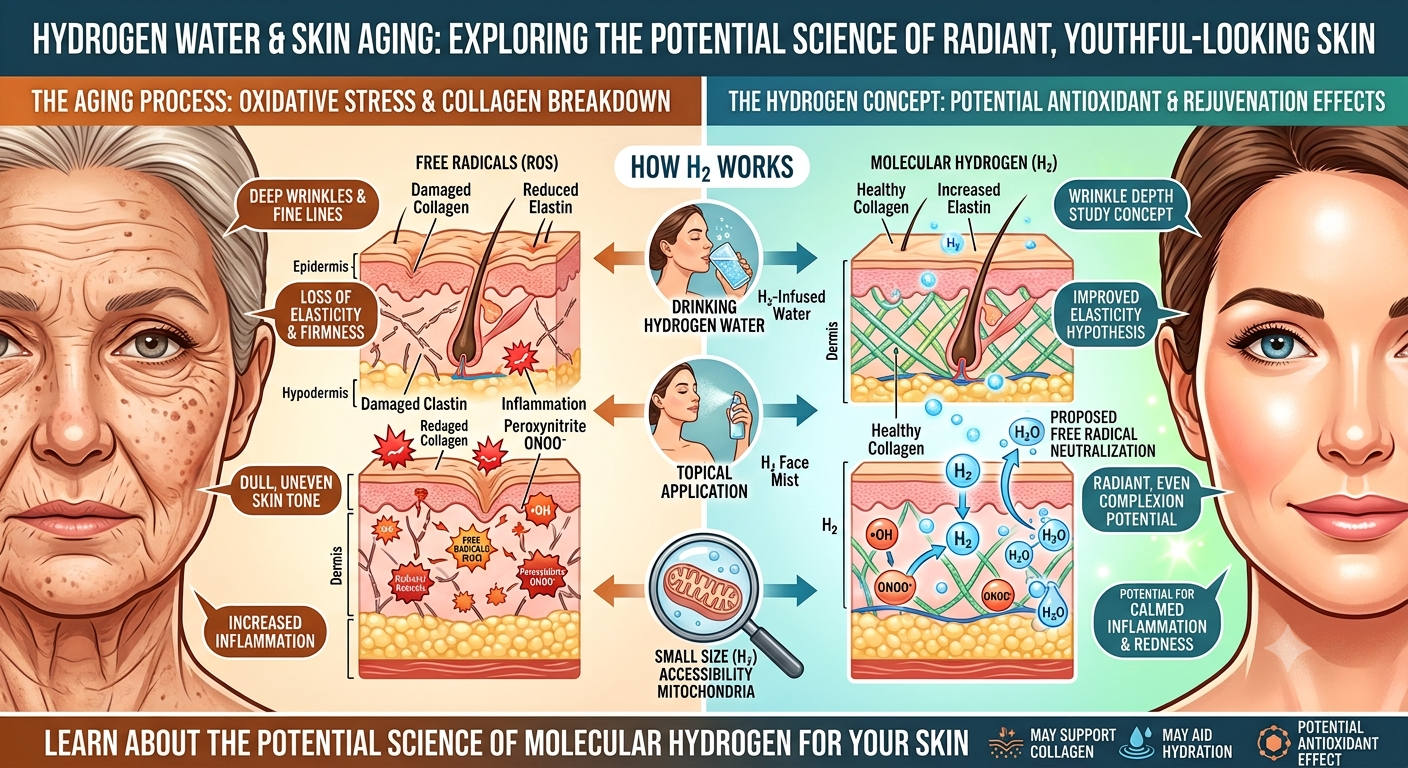
Dermatology research has long linked visible skin aging to oxidative stress: reactive oxygen species (free radicals) generated by UV exposure, pollution, stress, and ordinary metabolism damage collagen and elastin fibers, slow cellular turnover, and contribute to the fine lines, sagging, and dullness we associate with aging skin. This is well-established dermatological science — it's why antioxidant serums (vitamin C, vitamin E, niacinamide) became a skincare category in the first place.
The limitation is that topical antioxidants only work on tissue they can physically reach. Skin's outer barrier is designed to keep things out, which is great for protection and frustrating for penetration. A lot of the oxidative load contributing to aging is happening systemically — inside cells, in the bloodstream, in mitochondria — not just in the top layers of skin a cream can reach.
Why Molecular Hydrogen Gets Discussed in This Context
Molecular hydrogen (H2) works differently from a topical antioxidant, which is the whole reason it comes up in anti-aging conversations. As the smallest molecule that exists, H2 diffuses readily across cell membranes and into places larger antioxidant compounds simply can't reach as efficiently. Research reviews on H2's mechanism (e.g., PMC11795818) describe it as a selective antioxidant — it preferentially neutralizes the most damaging free radicals (hydroxyl radical and peroxynitrite) while leaving the beneficial reactive oxygen species your cells use for normal signaling intact. It's also associated with activating your body's own internal antioxidant systems (the Nrf2 pathway), which support enzymes like glutathione and SOD that your body already relies on to manage oxidative load.
To be direct about what this does and doesn't mean: this is a plausible, mechanistically-grounded reason hydrogen water gets adopted by people focused on skin and aging, not a clinical promise that drinking it will visibly reduce your wrinkles. We're not aware of large-scale, skin-specific clinical trials proving that outcome, and you should be skeptical of any brand (including ours) that implies otherwise. What the research does support is a general, structure-function role in reducing markers of oxidative stress and inflammation body-wide — skin included, since skin is a metabolically active organ affected by the same oxidative processes as everything else.
The Detail Almost Nobody Mentions: Water Quality Cuts Both Ways
Here's a wrinkle (no pun intended) that's specific to hydrogen water and rarely discussed in beauty content: how the hydrogen is generated matters for skin, not just for hydrogen output.
Chlorine exposure has documented associations with skin irritation and dryness in dermatological research — one more reason plain tap water isn't always doing your skin favors. Separately, low-quality hydrogen generators without proper proton-exchange membranes (PEM) can produce unwanted electrolysis byproducts, including chlorine and ozone compounds, in the process of making "hydrogen water." If your goal is supporting skin health, a device that solves one oxidative problem while introducing another isn't the win it looks like on the label.
This is the actual reason to care about the electrode and membrane quality inside a hydrogen bottle or pitcher — not just the PPB number on the box. True Marqet's bottles and pitchers use SPE (solid polymer electrolyte) and PEM technology with titanium/platinum electrodes specifically to generate hydrogen while minimizing those unwanted byproducts.
Building It Into a Routine (Without Overcomplicating It)
If you want to try adding hydrogen water as the "inside-out" complement to a topical routine, the practical version looks like this:
- Consistency over intensity. General intake guidance in the research ranges from about 1–4 liters per day; some studies used protocols around four 400 mL servings. There's no evidence more is dramatically better — steady daily intake matters more than maxing out volume.
- Give it real time. Across the broader H2 research base, noticeably felt effects (energy, reduced fatigue, general wellbeing) are commonly reported around the 4–6 week mark, with some effects (like anaerobic exercise measures) showing up faster. Skin turnover cycles run on a similar or slower timeline — this is not a same-week skincare hack.
- Pair it with what already works. Hydrogen water doesn't replace sunscreen, retinoids, a dermatologist, or a solid topical antioxidant routine. It's a supporting habit, not a substitute. Some people in this audience pair it with a daily collagen supplement, on the logic that one supports the raw material (collagen) while the other supports the oxidative environment collagen has to survive in. That's a reasonable stack to consider, not a proven combination we're claiming works better together.
- Introduce gradually. Higher H2 intake can cause mild digestive adjustment (bloating, looser stools) in some people initially. Start with one serving a day and build up.
How to Actually Track It (Instead of Just Hoping)
True Marqet's whole approach is built around proving things rather than asserting them — "whatever your reason for trying hydrogen water, there should be a way to check if it's doing anything." For skin and aging specifically, that doesn't require a lab. A reasonable, no-cost self-tracking approach:
- Baseline photos, same conditions. Same lighting, same time of day, same distance, before you start. Repeat every 2 weeks. This is the single most reliable way to notice real change versus wishful thinking, and it costs nothing.
- A simple hydration/texture note. Once a week, jot a one-line note on how skin feels (tight, flaky, plump, even-toned) rather than trying to remember months later.
- Consumer skin-analysis tools, if you already own one. Handheld skin analyzers and hydration meters marketed to consumers (not the clinical corneometer/cutometer equipment dermatology offices use, but the consumer-grade equivalents) can add a number to track alongside photos. They're optional, not required.
- Keep everything else constant while you test. If you change three products and your water at once, you won't know what did what. Isolate the variable if you actually want a real answer, not just a good story.
The Honest Summary
Oxidative stress is a real, well-documented contributor to visible skin aging. Molecular hydrogen is a legitimate, mechanistically distinct antioxidant with a growing research base — but that research base supports general structure-function benefits (reduced oxidative stress and inflammation markers), not a specific, proven claim that it reverses or prevents skin aging. Anyone selling it to you as a wrinkle cure is overstating the science, and we'd rather you know that going in than feel misled six weeks later.
What we'd actually stand behind: it's a defensible addition to a routine already built around sun protection and topical antioxidants, it's inexpensive to try relative to most skincare categories, and — unlike a lot of what's on a bathroom shelf — you can build a genuinely simple way to track whether it's doing anything for you personally.
These statements have not been evaluated by the FDA. This product is not intended to diagnose, treat, cure, or prevent any disease. Individual results may vary. Always consult your physician or dermatologist before starting any new supplement or wellness routine.
Try it: True Marqet H2B1 Hydrogen Water Bottle — a portable, rechargeable way to build a daily hydrogen habit alongside your existing skincare routine.