
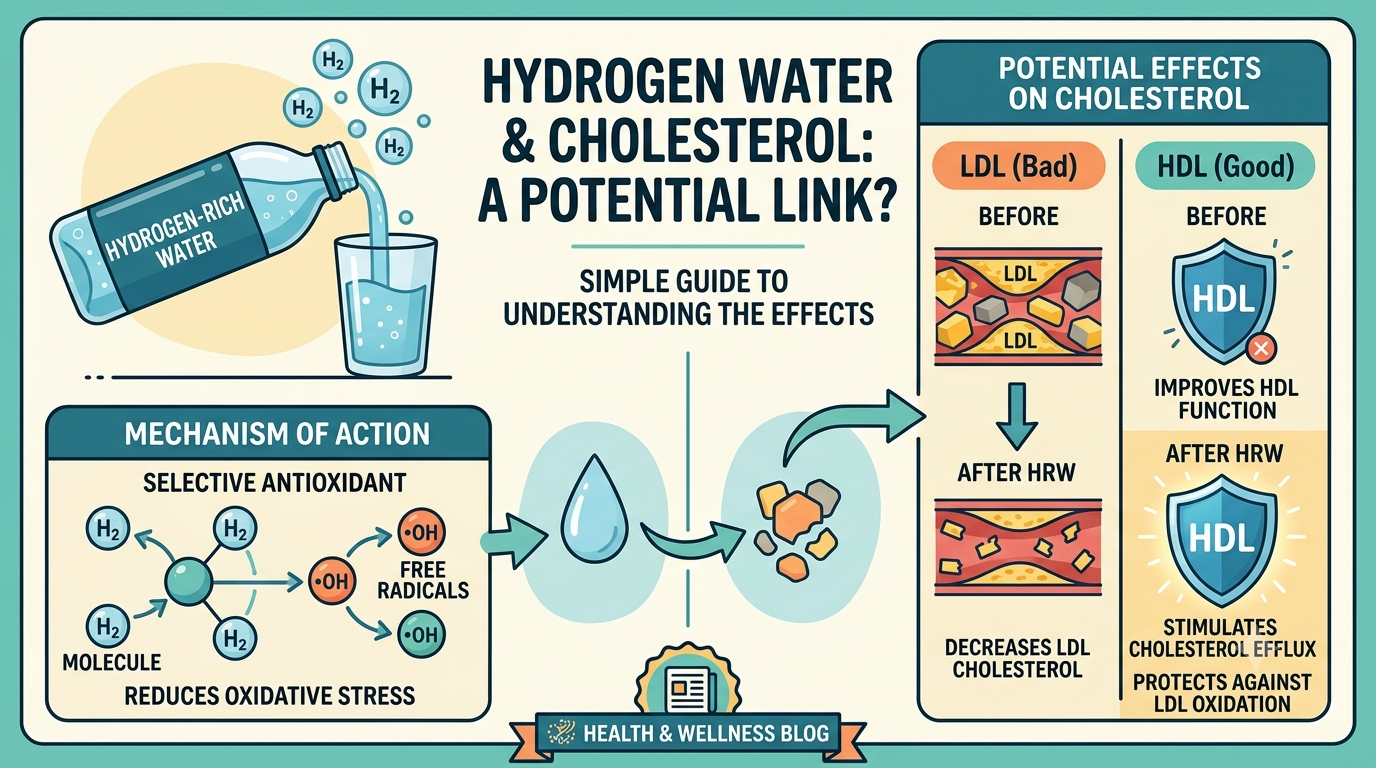
Search "does hydrogen water lower cholesterol" and you'll mostly find two kinds of answers: brands saying yes without much detail, and skeptics saying no without much detail either. As of March 2026, there's actually a better answer, because a team of researchers ran the first systematic review and meta-analysis built specifically to isolate hydrogen-rich water's effect on lipid profiles in overweight and obese adults. They pooled 13 randomized controlled trials and 757 people. The result isn't a clean yes or no — it's a real, measurable effect that's considerably smaller than most marketing around it implies.
What the 2026 Meta-Analysis Actually Found
The review, published in Diabetology & Metabolic Syndrome by Ye and colleagues, searched Scopus, PubMed, Web of Science, and Embase for trials published through November 2025 (Ye et al., 2026). After screening 2,821 records down to 12 qualifying articles covering 13 trials, they pooled the results using a random-effects model. Here's what came out:
- Total cholesterol: down 6.71 mg/dL on average (95% CI −10.38 to −3.04, p<0.001)
- LDL cholesterol: down 3.21 mg/dL on average (95% CI −6.31 to −0.10, p=0.043)
- HDL cholesterol: down 1.16 mg/dL on average (95% CI −1.92 to −0.40, p=0.003) — a small reduction, and notably the wrong direction, since higher HDL is usually the goal
- Triglycerides: no statistically significant change (95% CI −17.75 to 9.32, p=0.54)
Statistically, the total cholesterol and LDL drops are real — the confidence intervals don't cross zero, and the p-values are solid. Practically, they're small. A 6.71 mg/dL drop in total cholesterol is roughly what you might see from a modest dietary tweak, not what you'd see from a statin, which routinely cuts LDL by 30–50%. The study authors said as much themselves, concluding the effects are "below thresholds considered meaningful for cardiovascular risk reduction" and shouldn't be used to justify hydrogen water as a routine lipid-lowering therapy on its own.
Who Was Actually in These Studies
This is the part most coverage skips. Every trial in the meta-analysis required a mean baseline BMI of 25 or higher, and most participants also had an existing metabolic condition — metabolic syndrome, type 2 diabetes, non-alcoholic fatty liver disease, hyperuricemia, or impaired fasting glucose. These weren't healthy adults with normal lipid panels drinking hydrogen water as a wellness add-on. They were people already dealing with a metabolic issue, recruited largely from outpatient clinics and hospital registries.
That matters for anyone reading the numbers above and wondering what to expect personally. If your cholesterol is already in a normal range, this body of research doesn't say much about you one way or the other — nobody's tested that population specifically at this scale.
Why Individual Trials Show Bigger Numbers Than the Average
Pooled averages flatten out a lot of variation, and two of the trials folded into this meta-analysis make that obvious.
A 24-week trial by LeBaron and colleagues gave 60 adults with metabolic syndrome high-concentration hydrogen-rich water — more than 5.5 millimoles of H2 per day — and found considerably larger shifts than the pooled average: total cholesterol down roughly 18 mg/dL, triglycerides down roughly 47 mg/dL, LDL down, HDL up (the opposite direction from the pooled result), fasting glucose down from about 121 to 103 mg/dL, and HbA1c down about 12% (LeBaron et al., Diabetes, Metabolic Syndrome and Obesity, 2020).
An older, frequently cited trial goes back to 2008. Kajiyama and colleagues ran a randomized, double-blind, placebo-controlled crossover study in 30 people with type 2 diabetes and 6 with impaired glucose tolerance, comparing 900 mL/day of hydrogen-rich water against placebo water over 8 weeks. Modified LDL dropped 15.5%, small dense LDL dropped 5.7%, and urinary 8-isoprostanes — a marker of oxidative stress — dropped 6.6%. Glucose tolerance testing normalized in 4 of the 6 impaired-glucose-tolerance patients (Kajiyama et al., Nutrition Research, 2008).
Neither of those is a claim that hydrogen water treats diabetes or prevents disease — both are describing what was measured in a specific, small trial. But the pattern across the meta-analysis's own subgroup data is consistent: the trials with higher hydrogen doses and longer durations (LeBaron's ran 24 weeks; several others in the pooled average ran 8) tended to report bigger changes. The meta-analysis authors flag this as hypothesis-generating rather than proven, since the subgroups involved are small. Still, it's a reasonable explanation for why any single trial can look more dramatic than the pooled number.
So Should You Drink Hydrogen Water for Cholesterol?
If you already have elevated cholesterol, metabolic syndrome, or prediabetes, the honest read is: there's a real, small, research-backed effect here, mostly seen with consistent daily intake over two to six months, and it's worth discussing with your doctor as something to add, not something to replace medication or lifestyle changes with. If your numbers are normal already, there's no evidence one way or the other that it will move them further.
One detail worth noticing across every trial that found an effect: none of them tested a glass here and there. The volumes ranged from 900 mL to 2 liters a day, sustained daily, for two to six months straight. That's a real commitment if you're refilling a 16-ounce bottle five or six times a day. It's part of why our H2POUR pitcher holds 68 ounces — close to the 2-liter upper end used in these studies — since the research isn't testing occasional sips, it's testing sustained daily volume, and the size of the container you actually reach for tends to decide whether "daily" holds up past week two.
Frequently Asked Questions
Does hydrogen water lower cholesterol?
In pooled clinical trial data, yes, modestly. A 2026 meta-analysis of 13 randomized trials found average reductions of 6.71 mg/dL in total cholesterol and 3.21 mg/dL in LDL cholesterol. The researchers describe the effect as too small on its own to meaningfully reduce cardiovascular risk, and most participants already had a metabolic condition going in.
How much hydrogen water do you need to drink to see an effect?
The trials that reported effects used between 900 mL and 2 liters a day, for 8 to 24 weeks. Studies with higher hydrogen concentrations and longer durations tended to report larger changes, though researchers consider that pattern preliminary rather than settled.
Does hydrogen water affect blood sugar?
A small number of trials suggest it might. In a 2008 study, 8 weeks of hydrogen-rich water normalized glucose tolerance testing in 4 of 6 patients with impaired glucose tolerance and improved markers of oxidative stress in patients with type 2 diabetes. That's early evidence from a small sample, not an established treatment effect.
Is hydrogen water a substitute for cholesterol or diabetes medication?
No. None of the research reviewed here tested hydrogen water in place of statins, metformin, or other prescribed treatment — participants in every trial continued their normal medical care. If you have diagnosed high cholesterol or diabetes, this is something to bring up with your doctor, not something to substitute in on your own.
Does hydrogen water help with fatty liver disease?
A couple of small pilot trials have looked at this. One found reduced liver fat and improved liver enzyme markers after consistent hydrogen-rich water intake over several weeks, in groups of 12 to 30 people. The sample sizes are small and results haven't been replicated at scale, so this counts as an active research question, not a settled answer.
Will hydrogen water help my cholesterol if it's already normal?
There's no good evidence either way. Almost every trial in the 2026 meta-analysis enrolled adults who were overweight or obese with an existing metabolic condition, not people with normal lipid panels to start. That population simply hasn't been studied at scale.
None of this makes hydrogen water a cholesterol drug, and no serious researcher in the space is claiming otherwise. The honest summary of 18 years of trials — from Kajiyama's 2008 diabetes study to this year's 757-person meta-analysis — is that the effect is real, small, and concentrated in people who already have a metabolic issue to correct. That's a less exciting sentence than most hydrogen water marketing offers. It also happens to be the one the data supports, which is the version we'd rather tell you.
This article is for informational purposes only and is not medical advice. Talk to your doctor before making changes related to cholesterol, blood sugar, or any diagnosed condition.