
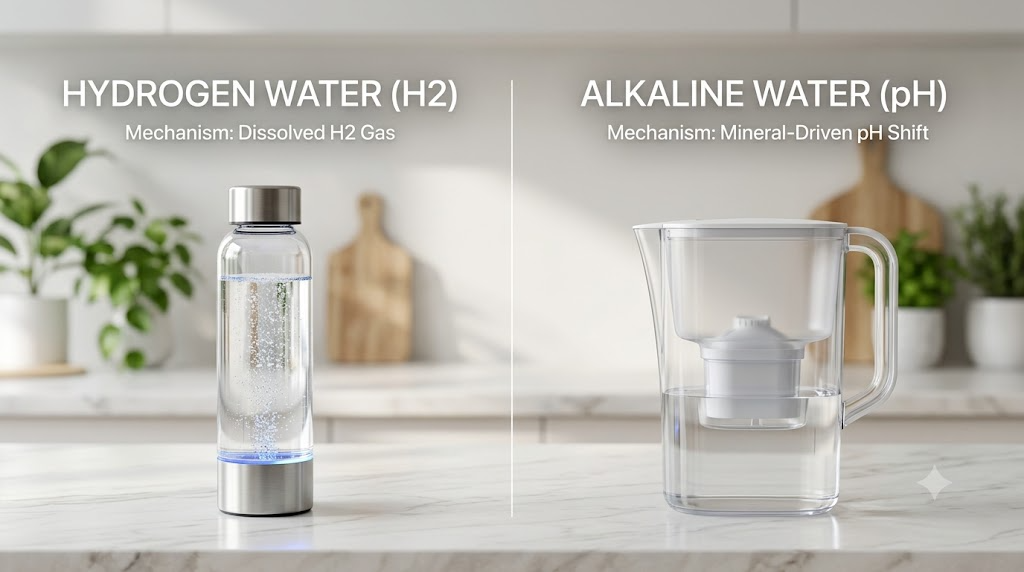
A lot of people land on "hydrogen water" after typing something closer to "does alkaline water actually do anything," and the two get used almost interchangeably in marketing copy. They shouldn't be. They're different chemistry, made by different equipment, with different — and unequal — evidence behind them.
What "alkaline water" actually is
Alkaline water usually means one of two things: naturally occurring mineral water with a higher pH (some bottled brands from volcanic regions sit around pH 8–10), or water run through an electrolysis ionizer that splits a stream into an alkaline (higher pH) side and an acidic side, then serves you the alkaline half. The pH shift comes from dissolved minerals — calcium, magnesium, potassium — not from any new molecule being added.
What "hydrogen water" actually is
Hydrogen water means water with dissolved molecular hydrogen gas (H2) in it — a diatomic gas, the smallest molecule there is, infused or electrolytically generated so it stays suspended in the water rather than reacting with anything. Done right, this doesn't meaningfully change the water's pH at all; you're adding a dissolved gas, not a mineral. The production method matters here too. Cheap "hydrogen" bottles sometimes use bare electrodes that also throw off chlorine or ozone as a byproduct. True Marqet's H2B1, for example, runs SPE/PEM electrolysis — a proton-exchange membrane that isolates the hydrogen-generating reaction — specifically to avoid that. It's a different piece of engineering solving a different problem than an ionizer's split-stream design.
What the alkaline water research actually shows
A June 2026 narrative review in Frontiers in Medicine (Deen, "The health benefits of alkaline water: is it a fact or marketing myth?") is about as current a read as exists on this. The honest summary: alkaline water does not measurably shift blood or urine pH in healthy people — the body's buffering systems handle that regardless of what you drink. The most consistent, reproducible benefit in the literature is gastrointestinal: alkaline water can inactivate pepsin and has shown symptom improvement for reflux and dyspepsia in clinical trials, especially bicarbonate-rich formulations. Everything past that — metabolic effects, antioxidant activity, immune function, anti-aging — the review calls "inconsistent" and "largely derived from small or preclinical studies," and it explicitly says alkaline water shouldn't be routinely recommended in primary care. It also flags caution for people with chronic kidney disease, anyone on acid-suppressive medication, pregnant women, and children — not because it's dangerous for most people, but because the mineral load isn't nothing.
What the molecular hydrogen research actually shows
Molecular hydrogen has a different profile, backed by a different body of work. A 2025 comprehensive review by Yıldız, LeBaron, and Alwazeer in Biochemistry and Biophysics Reports lays out the mechanism: H2 acts as a selective antioxidant, meaning it preferentially reacts with the most damaging free radicals — the hydroxyl radical and peroxynitrite — while leaving beneficial signaling ROS alone. That selectivity is the part regular antioxidants like vitamin C don't have; they scavenge more indiscriminately. H2 also appears to activate the Nrf2 pathway, which upregulates the body's own antioxidant enzymes rather than just donating electrons and getting used up.
On the applied side, a 7-day intake study found no change in aerobic performance but did find anaerobic gains — higher peak and mean power output, a lower fatigue index, and reduced post-exercise blood lactate compared to placebo. That's a narrower and more specific finding than "boosts performance," and it's worth being precise about it: this is short-duration, high-intensity output, not endurance capacity.
Neither body of research says either type of water prevents or treats disease, and neither should be read that way. What they show is two different mechanisms, tested in two different ways, with different strength of evidence behind each.
Can a product do both?
Some bottles on the market combine hydrogen generation with a mineral/alkaline stage in one device, since the two mechanisms aren't mutually exclusive — you can add dissolved H2 to water that also happens to carry a higher mineral pH. That's a legitimate design choice, not a contradiction. It doesn't mean the combination has been studied as a combination, though; the evidence above is specific to each mechanism on its own.
The practical read
If what you're chasing is the gastrointestinal comfort angle — less reflux, easier digestion — the current evidence points toward the alkaline/mineral side, particularly bicarbonate-rich water. If you're after the antioxidant and post-exercise recovery angle, the evidence base sits with dissolved molecular hydrogen, measured in PPB, not with pH. They're not competing for the same use case, which is probably why so much marketing blurs them together — it's easier to sell "healthier water" as one thing than to explain two separate mechanisms.
FAQ
Is hydrogen water the same as alkaline water?
No. Alkaline water raises pH using dissolved minerals; hydrogen water adds dissolved molecular hydrogen gas without meaningfully changing pH. They're different chemistry from different equipment, and a bottle can be one, the other, or — less commonly — both.
Does alkaline water actually change your body's pH?
According to a 2026 peer-reviewed review, no — blood and urine pH in healthy people aren't measurably shifted by drinking alkaline water, because the body's own buffering systems regulate that tightly regardless of intake.
Which is better for digestion, alkaline or hydrogen water?
Alkaline water, particularly bicarbonate-rich formulations, has the more consistent clinical evidence for reflux and pepsin-related symptoms. Molecular hydrogen hasn't been studied primarily as a digestive intervention — its evidence base is centered on oxidative stress and exercise recovery instead.
How do I know a bottle is actually producing hydrogen, not just claiming it?
Hydrogen concentration is measured in PPB (parts per billion) using a hydrogen test kit or dissolved-hydrogen meter — a separate tool from the bottle itself, since none of these generators display or track that number live. Reputable brands publish lab-tested PPB figures rather than vague "infused with hydrogen" language.
Can one product combine hydrogen and alkaline water?
Yes — some devices generate dissolved hydrogen and shift mineral content in the same cycle, since the two mechanisms don't conflict. That said, "combines both" isn't the same as "both benefits have been studied together" — treat each claim on its own evidence.
Is alkaline water safe for everyone?
Generally yes for healthy adults in normal amounts, but a 2026 clinical review specifically flags caution for people with chronic kidney disease, anyone on acid-suppressive medication, pregnant women, and children, given the added mineral load. Check with a doctor if you fall into one of those groups.
True Marqet builds water systems around what the evidence actually supports — not what's easiest to market. Clean water first. Enhanced water next.