A water treatment dealer will spend two hours testing a customer's water, sizing a softener to the home's fixture count and grain hardness, and scheduling an install with a follow-up maintenance visit eighteen months out. Then the filter light on that same customer's refrigerator comes on, and the dealer has nothing to offer. The customer drives to a big-box store or orders a filter online from a brand the dealer has never heard of. The dealer didn't lose that sale on service — the line card just doesn't cover it, and a routine, repeat purchase goes to whoever ranks first in a search result instead.
Plumbing supply distributors have a version of the same gap. A contractor account that already buys fittings, valves, and softener components at the counter or from a field rep will still search “refrigerator water filter” on a phone instead of adding it to the next order — not because the distributor couldn't get it, but because nobody ever mentioned it was something they carried.
The Business Quietly Leaking to a Search Bar
Plumbing distribution overall isn't moving to e-commerce as fast as the headlines suggest. In a survey of 896 wholesale distributors across sectors (68 identifying plumbing as their primary business), the American Supply Association's Distribution Strategy Group research found e-commerce revenue climbed from 9.3% of total sales in 2023 to 12.2% in 2025 — real growth, but traditional channels (phone orders, counter sales, field sales) still command roughly 88% of revenue, and field sales reps remain the single most effective demand-generation channel by a wide margin over any digital vehicle (Supply House Times / American Supply Association, January 2026).
That's the reassuring half of the finding. The other half is worth paying closer attention to: the same research found that maintenance and repair buyers ordering familiar products in predictable quantities show the highest digital adoption rates of any customer segment. A refrigerator filter is close to a textbook example of that category — a known part, reordered on a predictable cycle, for a problem the customer has already diagnosed. It's exactly the kind of purchase most likely to go to a search bar instead of a counter, and exactly the kind a distributor can keep in-house simply by carrying it.
Why This Fits How Water Treatment Dealers Already Operate
Most water treatment dealers already run a version of this business model. Trade coverage of the residential dealer channel describes independent regional dealers, “often multigenerational family firms,” as businesses that sell across brands and “frequently assemble equipment from wholesale components” rather than manufacturing everything themselves (Water Quality Wire, July 2026). Sourcing a wholesale-priced component and presenting it under your own customer relationship is already normal in this channel. A refrigerator filter is just a smaller, faster-turning version of the same practice.
It also matters more than it used to. That same coverage notes sustained consolidation pressure in residential water treatment, with private capital acquiring independent dealers at a steady pace — a familiar pattern of recurring revenue and fragmented ownership meeting an active buyer. Every product category that keeps a customer calling the same familiar business, instead of searching cold, is a small piece of the retention case an independent dealer needs to make. Regulatory attention to PFAS and lead is also sending more water-quality-conscious customers into the channel in the first place, which only raises how often the refrigerator filter question comes up. The Water Quality Association — a trade group representing more than 2,500 manufacturer, supplier, dealer, and distributor member companies — has tracked this attention closely through its own PFAS resources for the industry (wqa.org).
What Private Labeling Actually Buys You
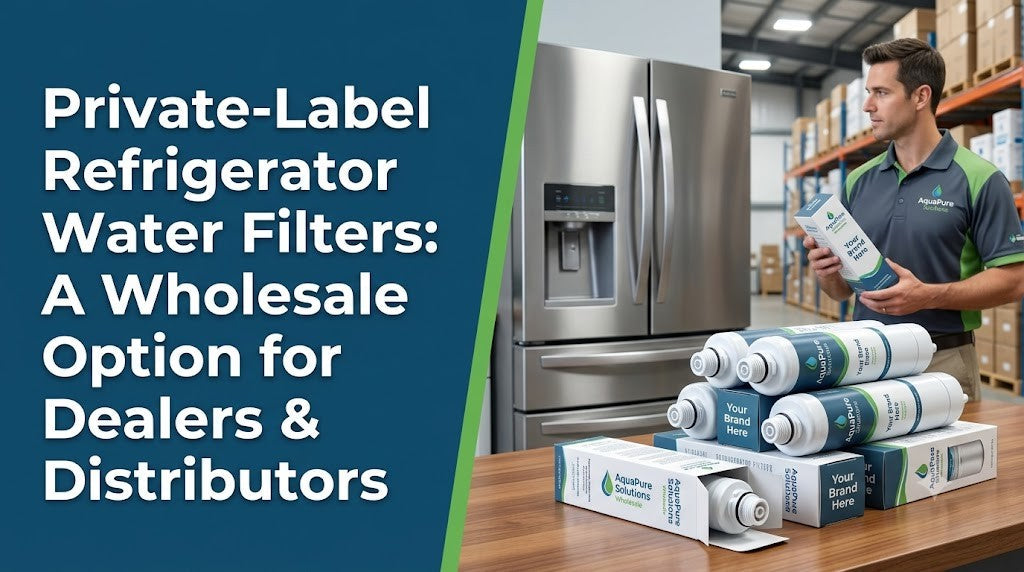
True Marqet's wholesale program includes custom packaging and white-label options on request for qualifying orders — a detail that matters more to a dealer or distributor than to an end-use reseller. Handing a customer a box printed with a manufacturer name they don't recognize is a missed impression at best. At worst, it's a name they remember and search directly the next time they need a filter, cutting the dealer out of a sale they used to own. A box that carries the dealer's own name reinforces the same relationship the water test and the installation already built.
The program also price-matches, which addresses the hesitation that normally slows down a first order from an unfamiliar vendor — nobody wants to commit shelf space or a private-label print run before confirming the cost basis is competitive.
Anyone evaluating fit can see current terms on True Marqet's wholesale program page, including the full benefits list and how to request a quote.
The Filter Families Worth Knowing
You don't need the full catalog to cover most of what a typical customer base will ask for. A short list of filter families accounts for the large majority of refrigerators in service:
- Whirlpool / Kenmore / Everydrop — EDR1RXD1 / W10295370A
- Frigidaire / Electrolux / Pur — split across three non-interchangeable families by model year: FPPWFU01/PWF-1, ULTRAWF, and WF3CB
- GE — XWF / MWF
- LG — LT1000P / ADQ747935
- Samsung — DA29-00020B / HAF-CIN
- Bosch — UltraClarity Pro / BORPLFTR50
Higher-end and built-in installations may call for a Sub-Zero-compatible cartridge as well. Because there's no minimum order quantity, a dealer or distributor can start with the one or two families that best match its own customer base and expand only as reorders confirm the demand, rather than committing to the full list on the first order.
No MOQ and Price Match Lower the Cost of Testing the Category
Adding a new SKU category is usually a bigger commitment than it sounds — warehouse space, a minimum buy-in, a new vendor relationship to manage. True Marqet's structure is built to remove most of that friction from a first order: no minimum order quantity, price matching, freight and customs built into the quote instead of appearing as a surprise later, free shipping on orders of $500 or more, and long shelf life on the filters themselves, so early inventory isn't a use-it-or-lose-it bet. Payment runs through PayPal, Payoneer, wire/ACH, or credit card — standard enough to fit most distributor and dealer AP setups without an exception process.
One Distinction Worth Keeping Straight: NSF/ANSI 42 vs. 53
Anyone selling softeners and reverse osmosis systems already reads certification numbers for a living — NSF/ANSI 44 for softeners, NSF/ANSI 58 for RO. Refrigerator filters fall under a different standard, and it's worth stating plainly rather than letting it blur. Most of True Marqet's filters are certified to NSF/ANSI 42, which covers aesthetic reduction: chlorine, taste, and odor. That's a separate, narrower certification from NSF/ANSI 53, which covers contaminants with a health effect regulated by the EPA or Health Canada — the standard more likely to apply to the RO systems already on a dealer's line card (NSF's own standards guide lays out the distinction in full). It's a solid product for what it's certified to do. It shouldn't get described, on an invoice or in a sales conversation, as doing more than that.
Frequently Asked Questions
Can a water treatment dealer sell refrigerator filters under their own brand?
Yes. True Marqet's wholesale program offers custom packaging and white-label options on request for qualifying orders, so a dealer or distributor can put its own name on the box instead of a manufacturer brand the customer might search for independently later.
Is there a minimum order quantity to start a private-label refrigerator filter line?
No. There's no MOQ, so a dealer or distributor can start with one or two filter families that match its customer base and expand as reorders confirm demand, rather than committing to a full catalog on day one.
Do refrigerator filters carry the same certification as the softeners and RO systems we install?
No, and that's worth keeping straight. Most True Marqet refrigerator filters are NSF/ANSI 42 certified, covering aesthetic reduction (chlorine, taste, odor) — a different, narrower certification than NSF/ANSI 53 (health-effect contaminants) or the NSF/ANSI 44 and 58 standards that typically apply to softeners and RO systems. Check the individual product listing before representing it as more than a taste-and-odor certification.
What's the difference between buying wholesale as a distributor and buying wholesale as an end-use reseller?
Both run through the same no-MOQ wholesale program. The difference is downstream: an end-use reseller lists the product for sale directly to consumers on a marketplace, while a distributor or dealer typically sells it as part of an existing service relationship or contractor/counter channel, and can request white-label packaging to match.
Does True Marqet handle freight and customs on larger distributor orders?
Yes. Freight, customs, and duties are built into the wholesale quote rather than added as a separate line item later, and orders of $500 or more ship free.
What payment methods are available for a distributor or dealer account?
PayPal, Payoneer, wire/ACH transfer, and credit card.
Ready to Add Filters to Your Line Card?
If your customers are already sourcing refrigerator filters somewhere else — a big-box aisle, a marketplace listing, a brand they found on their own — that's a routine, repeat sale currently going around you instead of through you. Visit True Marqet's wholesale program to see current pricing, MOQ, and white-label terms, or email wholesale@truemarqet.com directly with your customer base and the brands you run into most. True Marqet typically responds within one business day.