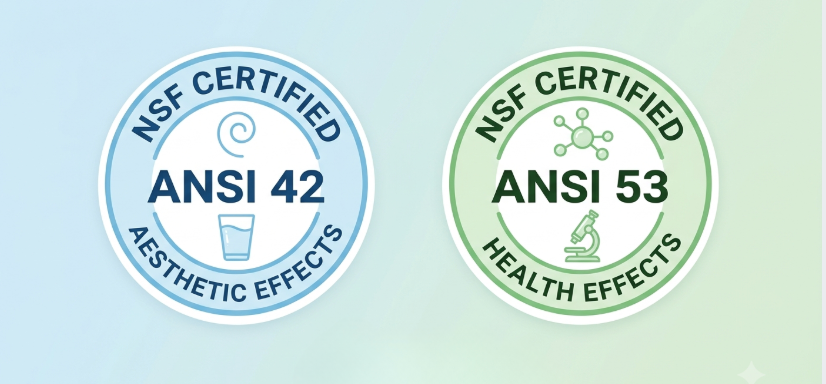
Pull up two refrigerator water filters that look nearly identical, and you'll often find one lists "NSF/ANSI 42" on the box and the other lists "NSF/ANSI 53." Neither listing explains what that number actually means, and most shoppers just assume the higher number is the better filter, or that any NSF mark means the same thing. It doesn't work that way. These are two different standards testing for two different categories of contaminants, and knowing which one you're looking at changes whether the filter is actually solving the problem you have.
NSF/ANSI 42: Aesthetic Effects
NSF/ANSI 42 covers what the standard itself calls "aesthetic effects" — substances that affect how water looks, tastes, and smells, rather than substances that pose a health risk. Filters certified under this standard are tested for chlorine and chloramine taste and odor, along with particulates like iron, manganese, zinc, and total dissolved solids. The Association of Home Appliance Manufacturers (AHAM) — whose member list includes Frigidaire, Whirlpool, Samsung, LG, Bosch, and Sub-Zero — runs a public education campaign built around exactly this distinction, and describes NSF/ANSI 42 plainly as covering "look and taste," not health.
This is the standard most everyday refrigerator carbon filters are built around. If your tap water is chlorinated and a little flat-tasting, a 42-certified filter is doing its job.
NSF/ANSI 53: Health Effects
NSF/ANSI 53 is a different standard entirely. It covers substances "considered established or potential health hazards" — lead and other heavy metals, asbestos, Cryptosporidium and Giardia cysts, volatile organic compounds, and, as of more recent revisions, certain PFAS compounds. The standard is revised almost annually. One detail worth knowing: the pass/fail threshold for lead reduction was actually tightened, dropping from 10 micrograms per liter to 5 in the 2019 revision, to reflect stricter state and federal proposals at the time.
Here's the part that trips people up: NSF/ANSI 53 certification is granular, not a blanket "healthy" stamp. A filter certified under 53 is certified for the specific contaminants it was tested against and lists on its own performance data sheet, not automatically every contaminant the standard covers. A filter that passed for cyst reduction isn't necessarily certified for lead, and vice versa. "NSF/ANSI 53 certified" on a box is the start of the question, not the end of it — the real answer lives on the data sheet.
So Which One Do You Actually Need?
For most households on a public municipal water system, this is less dramatic than it sounds. City water in the U.S. is already regulated for lead, cysts, and other health contaminants under the EPA's Safe Drinking Water Act before it ever reaches your fridge. A 42-only filter isn't leaving you exposed — it's handling the chlorine taste and odor that municipal treatment itself doesn't remove.
Where it matters more: private wells, which don't get the same EPA oversight municipal systems do, and older homes with lead service lines or older solder joints. In either case, look specifically for a 53 certification against the contaminant you're actually worried about, not just the number 53 somewhere on the packaging.
It's also worth knowing that only three organizations are accredited to run this testing and issue the certification: NSF International, the Water Quality Association, and IAPMO R&T. A certification claim not backed by one of those three isn't the same thing, regardless of how official the badge graphic looks.
True Marqet's own fridge-filter lineup states its certification plainly rather than leaving it to a badge graphic. The SK62 replacement, which covers Frigidaire's FPPWFU01 and PWF-1 filters, is NSF/ANSI 42 certified for aesthetic effects. Its listing doesn't carry a 53 claim, which is typical for a standard carbon-block filter built around taste and odor rather than health-contaminant reduction — worth knowing going in rather than assuming either way.
How to Check What Your Specific Filter Is Certified For
Both standards require manufacturers to make a performance data sheet available, either printed or online, listing exactly which contaminants a given model is certified to reduce and by how much. Before buying, look up the exact model number rather than trusting a certification logo on its own. Logos get reused loosely across product lines; data sheets are tied to one specific tested product.
FAQ
Is NSF/ANSI 53 always better than NSF/ANSI 42?
No. They test for different things entirely. A 53-only filter may do nothing for chlorine taste or odor, and a 42-only filter isn't tested for lead or cysts. The right filter depends on which problem you actually have, not which number is higher.
Can one filter be certified under both standards?
Yes, and it's common on higher-end systems. Later revisions of both standards were specifically harmonized — aligning testing cycles and sampling language — making dual certification more consistent for manufacturers pursuing both marks on one product.
Does an NSF/ANSI 42 certification mean my water isn't safe otherwise?
No. The standard's own scope applies to water already considered "microbiologically safe and of known quality." It's an aesthetic upgrade layered on top of water that's already presumed safe, not a fix for unsafe water.
Are refrigerator filters legally required to be certified?
No federal law requires it, which is part of why uncertified and counterfeit filters exist on the market at all. Major appliance manufacturers fund independent certification education for exactly this reason — it's the clearest way for a shopper to verify a real, tested filter.
How do I find out exactly what my filter model is certified for?
Check the manufacturer's performance data sheet, which both standards require to be available on the package or online, and match it against your exact model number rather than the certification logo alone.
Does a higher standard number mean a newer or better filter?
No. NSF/ANSI 42, 53, 58, and 401 are different standards covering different scopes — 58 covers reverse osmosis systems, for instance, and 401 covers incidental or emerging contaminants — not a version sequence where a higher number outranks a lower one.
Whatever filter you land on, the certification tells you more than the price tag does. Read the data sheet, not just the badge.