
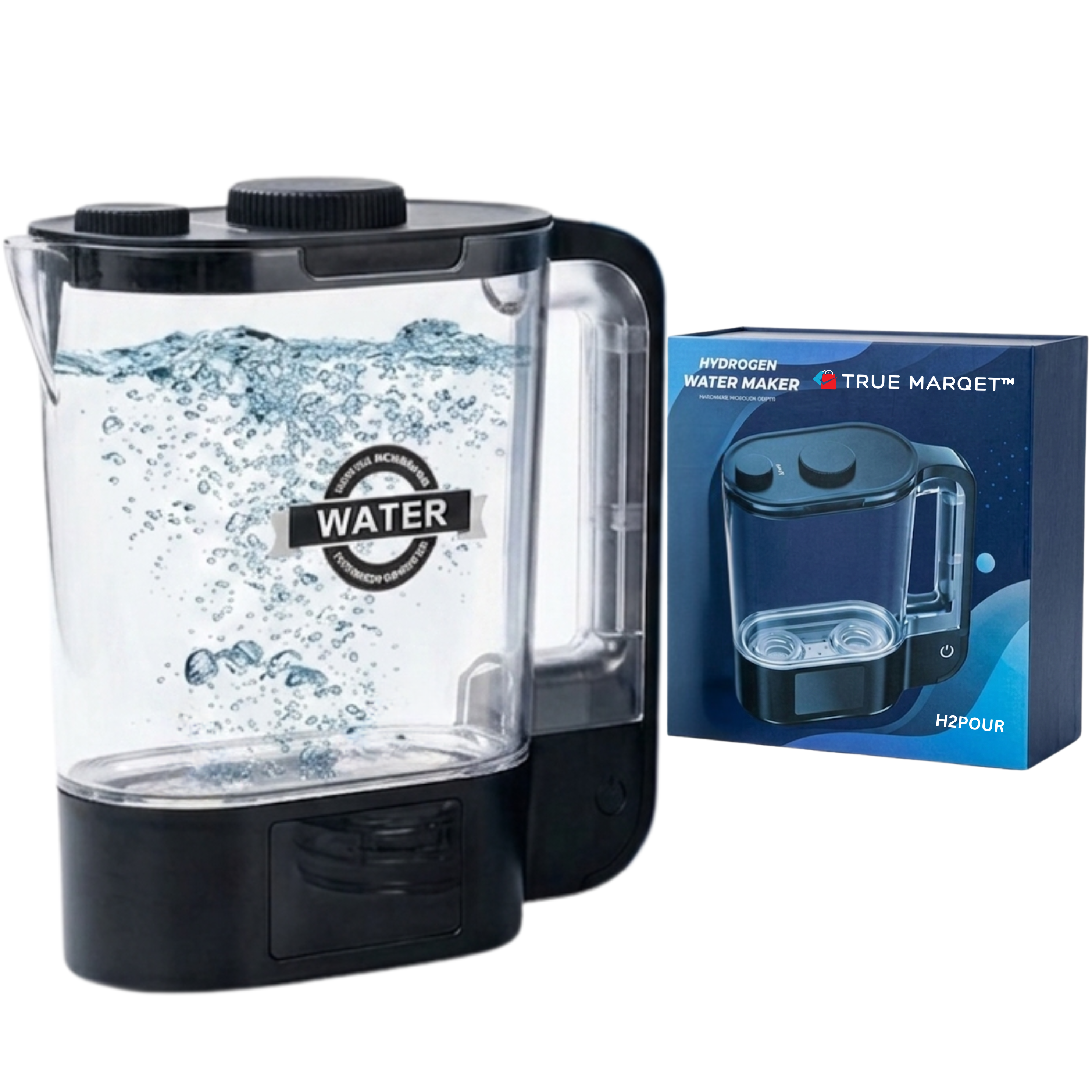
You start drinking hydrogen water, feel pretty good about the decision, and then three or four days in, your stomach starts making noises it doesn't usually make. Maybe there's some gas. Maybe things move a little faster than usual. The natural next thought is that something is wrong — either with you, or with the water. Neither is the likely answer, but it's a reasonable question, and it's one most hydrogen water marketing skips entirely, probably because "this might make you a little gassy at first" doesn't sell bottles. It also happens to be true for a subset of people, so here's what the actual research says, instead of the reassurance-only version.
What's Actually in the Water
Hydrogen water generators like True Marqet's use electrolysis — a proton exchange membrane (PEM) and electrodes split water molecules, releasing molecular hydrogen (H2) that dissolves into the water as tiny gas bubbles, measured in parts per billion (PPB). Nothing is added. There's no flavor, no color, no residue — just water with more dissolved H2 gas than it started with. The reason anyone bothers with this in the first place is that H2 is an unusually selective antioxidant: research published in Nature Medicine by Ohsawa and colleagues (2007) found that molecular hydrogen neutralizes the hydroxyl radical — the most damaging reactive oxygen species in the body — while leaving beneficial, signaling-related ROS untouched. That selectivity is the whole premise. It's also, notably, a paper about a gas doing chemistry inside cells, not about digestion.
Is Bloating Actually Normal?
Here's the part that usually gets left out: your gut is not encountering hydrogen gas for the first time when you drink hydrogen water. Gut bacteria produce H2 continuously, fermenting undigested carbohydrates as part of ordinary digestion — it's well-established enough that it's the entire mechanism behind the hydrogen breath test doctors use to diagnose small intestinal bacterial overgrowth (SIBO) and lactose intolerance. Your digestive system already generates, absorbs, and clears hydrogen gas every day without you noticing. Drinking hydrogen water adds a modest, temporary amount of the same gas on top of that baseline — not something biologically foreign.
That said, "modest and temporary" doesn't mean "never noticeable." True Marqet's own product research is direct about this: higher intake of hydrogen-rich water can cause minor digestive upset — some bloating, occasionally looser stools — in a subset of people, particularly if intake ramps up quickly. The standard, sensible advice is to introduce it gradually rather than jumping straight to several liters a day. That's not a workaround for a defect; it's the same advice you'd give someone about almost any new dietary habit that changes what their gut is processing.
What the Clinical Research Actually Shows
The broader safety data on molecular hydrogen is, frankly, better than most supplements ever get. A 2023 systematic review in the journal Molecules (Klaveness, "Molecular Hydrogen Therapy — A Review on Clinical Studies and Outcomes," Molecules 28(23):7785) examined 81 registered clinical trials and 64 published human studies and concluded that H2 administration — whether by water, inhalation, or saline — is safe for humans, with very few adverse reactions reported across the entire body of trials. The one caveat the review raises is H2's flammability in concentrated gas form, which is a handling and storage consideration, not a reason to worry about drinking a glass of hydrogen water.
That tracks with individual trial data too. In a 2020 double-blind, crossover study published in Biology of Sport (Timón et al., 38(2):269-275), 37 participants drank hydrogen-rich water daily for seven days as part of a performance study — and the researchers reported plainly that no one experienced any adverse effects related to the intake. Bloating specifically doesn't show up as a flagged concern in the trial literature at the rate you'd expect if it were a real safety signal rather than an occasional, mild adjustment response.
Two More Likely Explanations Before You Blame the Hydrogen
Before assuming H2 itself is the culprit, it's worth ruling out two more mundane causes:
You're just drinking more water than usual. If you went from barely finishing a bottle a day to 2-4 liters because you're trying to hit a hydrogen water target, that volume increase alone can cause temporary bloating or looser stools in almost anyone — hydrogen has nothing to do with it. Your gut needs a few days to adjust to any meaningful jump in fluid intake.
The device matters. Low-quality electrolysis units without a proper PEM membrane can produce unwanted byproducts — chlorine or ozone — alongside the hydrogen, and those byproducts are a real source of stomach and throat irritation that has nothing to do with H2 tolerance. It's a manufacturing-quality problem, not a hydrogen-safety problem, which is exactly why membrane and electrode quality (True Marqet uses SPE/PEM membranes with titanium and platinum electrodes) is worth paying attention to when you're choosing a generator.
How to Introduce Hydrogen Water Without the Adjustment Period
None of this requires overthinking. A few practical adjustments handle it for almost everyone:
- Start smaller. Instead of committing to a full liter-plus on day one, start with a single smaller serving — a compact bottle like the H2B1, at 420 mL per cycle, is a reasonable place to begin — and give your gut a few uneventful days before scaling up.
- Spread it out. Drinking your daily hydrogen water across several smaller servings tends to sit better than finishing it all in one sitting.
- Give it one to two weeks. Most people who notice anything at all report it easing as their intake becomes routine, which lines up with the "introduce gradually" guidance rather than suggesting anything is wrong.
- Talk to a doctor if it doesn't ease up. If digestive symptoms are more than mild or don't settle after a couple of weeks, treat it like you would any other new addition to your diet — mention it to a doctor, especially if you have an existing GI condition.
Frequently Asked Questions
Is it normal to feel bloated when you first start drinking hydrogen water?
Yes, for some people it is. It's typically mild and related to increased fluid intake and a temporary rise in dissolved gas, not a sign the water is unsafe. Introducing it gradually — smaller servings, built up over one to two weeks — usually prevents it or resolves it quickly.
Are hydrogen tablets different from hydrogen water bottles when it comes to side effects?
The hydrogen gas itself behaves the same way regardless of how it gets into the water. The difference is that hydrogen tablets typically use a magnesium-based reaction to generate H2, which adds a small dose of magnesium to the water — worth factoring in if you're already taking a magnesium supplement, since very high combined intake carries its own, separate risk of digestive upset.
Is hydrogen water actually dangerous in any situation?
The main safety consideration in the research isn't about drinking it — it's about handling concentrated H2 gas, which is flammable. That's a manufacturing and storage issue rather than something a consumer needs to think about when drinking a bottle of hydrogen-infused water.
How much hydrogen water should I drink while I'm adjusting?
There's no universal number, but starting with a single smaller serving and building toward the commonly referenced range of 1-4 liters a day over one to two weeks is a reasonable, low-drama way to get there without triggering the adjustment symptoms in the first place.
Does bloating mean my hydrogen water isn't actually generating hydrogen?
No — bloating and hydrogen output aren't related to each other. If you want to know whether a bottle is actually producing meaningful PPB levels, that requires a separate hydrogen test kit or strip; how your stomach feels isn't a reliable indicator either way.
True Marqet would rather tell you the unglamorous, accurate version of this than the version that only mentions upside. Hydrogen water is a well-studied gas dissolved in water, your gut is a system that already handles that gas every day, and the occasional adjustment period is a known, minor, well-documented part of changing any water habit — not a red flag.