
You search your fridge’s brand, order the first Frigidaire filter that comes up, and it doesn’t fit. Wrong shape, wrong housing, won’t twist into place. This isn’t user error. Frigidaire has sold at least three distinct refrigerator water filter designs over the years, and they are not interchangeable with each other. Buying by brand name alone is close to a coin flip.
Why Frigidaire Uses Three Different Filters, Not One
Refrigerator brands tend to redesign the filter housing whenever they redesign the door and interior layout, and Frigidaire’s lineup spans top-freezer, side-by-side, and French-door bottom-freezer models sold under both the Frigidaire and Electrolux nameplates. Each layout change tends to bring a new cartridge shape with it, and the older design doesn’t disappear the moment a newer one launches — both keep shipping in parallel across different model families for years afterward. Two Frigidaire refrigerators sitting next to each other in a showroom can easily take two completely different filters.
The Three Filter Families
WF3CB (PureSource 3)
A slim, push-in cartridge. It shows up in a lot of older side-by-side and some French-door Frigidaire and Kenmore-branded units, typically seating horizontally in the upper-right corner of the fresh food compartment.
ULTRAWF (PureSource Ultra)
A larger, round cartridge — and probably the single most cross-referenced Frigidaire filter part number out there. Depending on who’s selling it, you’ll see the same physical filter listed as CW-ULTRAWF, RF-02, or RWF1180. It’s generally the one appliance parts sites treat as the “default” Frigidaire filter, which is exactly why it gets ordered by mistake for fridges that actually need something else.
FPPWFU01 / PWF-1 (PurePour)
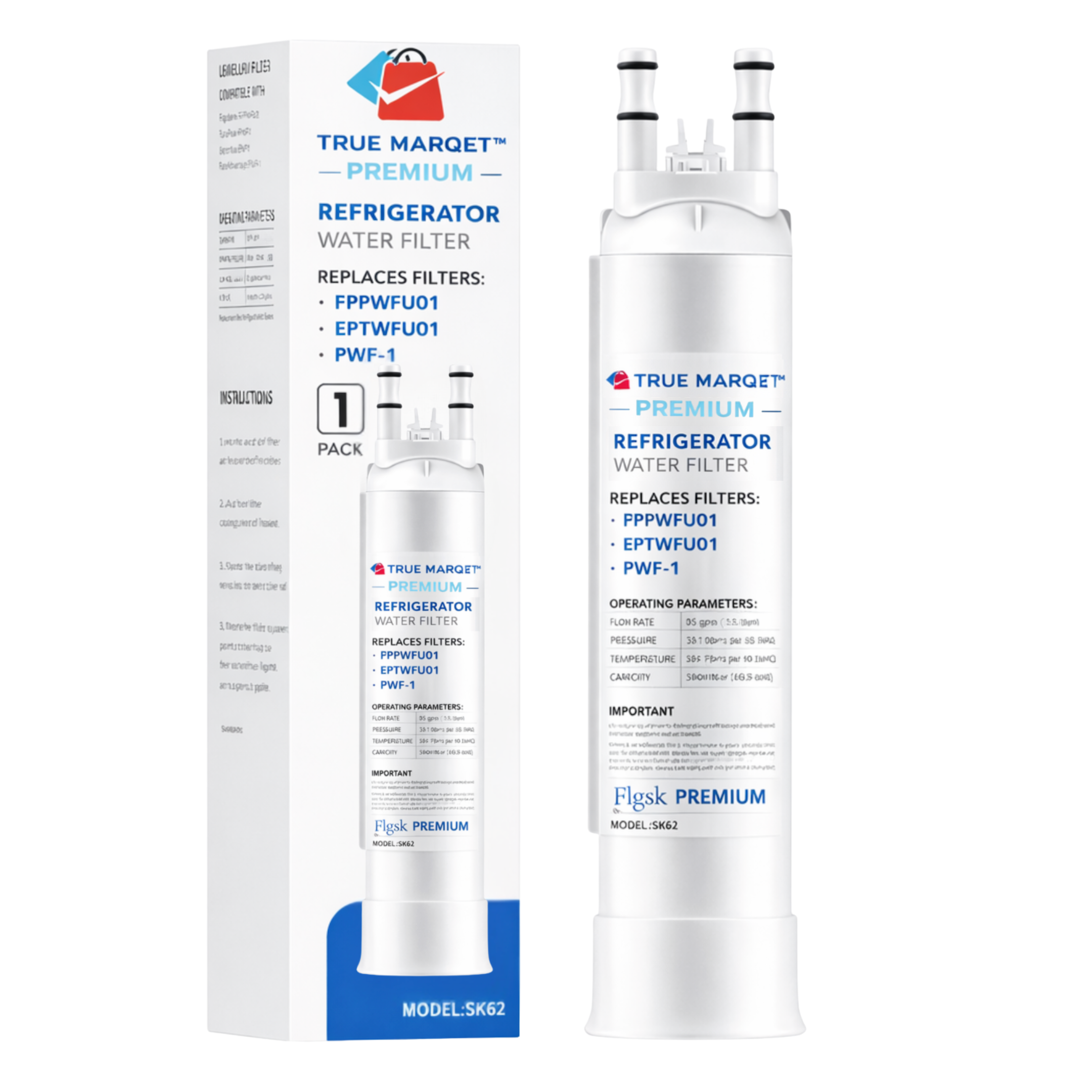
A round, twist-in cartridge used on newer French-door models sold under both the Frigidaire and Electrolux names — which is why the same physical filter turns up listed as EPPWFU01, FPPWFU01, HDFPPWFU01, or PurePour PWF-1 depending on which nameplate is on your particular fridge. If this is the style your fridge takes, the SK62 replacement covers all of those part numbers under one listing.
How to Tell Which One Your Fridge Actually Takes
Check the old filter first
The most reliable method by far: pull your current filter and read the part number printed directly on the housing. That number is ground truth — a better source than guessing from your fridge’s age, its finish, or what the salesperson said five years ago.
No old filter to check? Use your fridge’s model number
Your refrigerator’s full model number is usually on a sticker inside the fresh food compartment, on the door frame, or behind the crisper drawers. Match that specific model number against a filter’s compatibility list — not just the “Frigidaire” brand name — since the model number is what actually determines which of the three cartridges fits.
If you’re still not sure
Don’t install a filter and hope it seats correctly. A cartridge built for a different housing can sit crooked enough that water bypasses the filter media, or seals poorly enough to drip inside the fridge over weeks. If you’re stuck between two options, check compatibility against your model number before ordering rather than after a return.
What “NSF/ANSI 42 Certified” Does (and Doesn’t) Tell You
Each of these three filter families, in True Marqet’s own listings, is certified to NSF/ANSI 42 — the standard covering aesthetic effects like chlorine taste, odor, and particulates, independently tested and verified. That’s a different standard from NSF/ANSI 53, which covers health-related contaminants such as lead. An NSF/ANSI 42 certification is not a health-contaminant claim, and it shouldn’t be read as one. For the fuller breakdown of what each standard actually covers, see our explainer on NSF/ANSI 42 vs. 53.
Getting the right cartridge in the first place is still the bigger practical issue for most people shopping for a Frigidaire filter — no certification matters if the filter doesn’t seat correctly.
FAQ
How do I know if my Frigidaire needs the PWF-1, ULTRAWF, or WF3CB filter?
Check the part number printed on your current filter cartridge — that’s the most reliable answer. If you don’t have the old filter anymore, look up your refrigerator’s full model number (on a sticker inside the compartment or on the door frame) and match it against a filter’s listed compatibility, rather than assuming based on the fridge’s age or style.
Can I use a WF3CB filter in a fridge built for the ULTRAWF?
No. They’re sized for different housings. Forcing one into the wrong slot risks a poor seal, which can mean a slow leak inside the fridge rather than a clean fit. Match the part number rather than substituting one for the other.
Is EPPWFU01 the same filter as FPPWFU01?
Yes. Electrolux and Frigidaire are related brands, and the same physical cartridge is sold under slightly different part numbers depending on which nameplate is on the refrigerator. EPPWFU01, FPPWFU01, PWF-1, and PurePour PWF-1 all cross-reference to the same filter design.
What happens if I install the wrong filter?
At best, it won’t seat properly and your fridge may throw a filter-related error or restrict water flow. At worst, it seats poorly enough to leak. If you’re unsure which of the three families your fridge uses, verify against your model number before installing rather than guessing.
What does “NSF/ANSI 42 certified” mean for a Frigidaire replacement filter?
It means the filter has been independently tested to reduce aesthetic contaminants like chlorine taste, odor, and particulates. It’s a separate standard from NSF/ANSI 53, which covers health-related contaminants — an NSF/ANSI 42 certification on its own isn’t a health claim.
Where do I find my current filter’s part number?
It’s stamped directly on the plastic housing of the cartridge itself — check the top or side after you pull it out. If the old filter is long gone, your fridge’s model number (inside the compartment or on the door frame) works as a substitute reference point.